|
In this issue: Join us to celebrate OAP's 15th anniversary, major accomplishments, completion of multiple research cruises, education tools and major community meetings. |
View online
|
| |
|
The end of the fiscal year has been a pivotal time of reflection, strategic planning, and major accomplishments nationwide. This year, OAP celebrates 15 years of progress toward preparing our nation for the impacts of ocean and coastal acidification. The timely triennial OAP Research Community Meeting and annual mCDR PI Community Meeting convened our principal investigators and partners. These gatherings provided the opportunity to review major milestones and identify critical priorities moving forward. The release of the OAP FY25 Accomplishments highlights recent progress.
The following summer months were marked by a return to extensive field operations and research. After years of hiatus, two highly anticipated concurrent coastwide ocean acidification research cruises concluded their missions. Moving into the next fiscal year, we wish our entire community a safe and productive fall with successful deployments for those at sea and continued progress for those working across our nation.
|
| |
|
Fifteen years ago, an invisible crisis hit West Coast hatcheries as changing ocean chemistry decimated billions of oyster larvae, sparking a critical partnership between growers and scientists. This year, OAP marks its 15th anniversary with the launch of a new hub, highlighting the evaluation of ocean acidification science to service from our coasts to the Great Lakes. The interactive site celebrates a decade and a half of milestones in cutting-edge ocean observation, marine life protection, and vital national outreach that respond to mandates from the Federal Ocean Acidification Research and Monitoring Act. |
| | |
|
OAP FY25 Accomplishments Online
|
| |
|
The Ocean Acidification Program's annual accomplishments report for Fiscal Year 2025 is now live! This interactive report highlights major milestones, key publications, and vital progress made across the nation to track changing ocean chemistry, understand biological impacts, and build community resilience. Explore key achievements and dive into local efforts using the new interactive "OAP In Your State" map in the FY25 Accomplishments Report. |
| |
|
Funding & Job Opportunities
|
| |
|
Seeking external evaluator for education mini-grants |
|
The North American Association for Environmental Education (NAAEE) has released a Request for Proposals for an Evaluation and Communications Consultant for the new eeBLUE Ocean Acidification Education and Outreach Mini-Grants Program. This initiative will provide small grants to six Coastal Ecosystem Learning Centers (CELC) member institutions to integrate ocean and coastal acidification into their education and outreach efforts, building public literacy and fostering community-relevant environmental stewardship.
The total available budget for this contract is $20,000, including travel expenses for at least one conference presentation.
Proposals are due by 11:59 PM ET on November 20, 2026.
Image credit: NOAA Fisheries |
|
|
| |
|
Dual coastwide ocean acidification and coral reef missions successfully conclude
|
| |
|
The 2026 West Coast Ocean Acidification (2026) research mission concluded in late August, wrapping OAP’s two coastwide research missions. The 4th East Coast Ocean Acidification (ECOA-4) mission concluded earlier this summer, with a key achievement of surveying the most northern line ever. This marks the first-ever concurrent dual coast survey for ocean acidification. These coastal acidification research cruises collect the highest quality data on ocean chemistry, coupled with biological data, serving a benchmark for research and monitoring in these regions. The research cruises also occurred as a historic El Niño continues to build. Also newly released are online blogs and photo galleries. OAP recognizes the great contributions and willing coordination by NOAA labs and fishery science centers as well as cooperative institutes and academic partners to the success of these missions. OAP now begins planning for the 2027 mission in the Gulf.
In addition, the National Coral Reef Monitoring Program (NCRMP) successfully completed all scientific operations of the 2026 mission in American Samoa and Pacific Islands Heritage Marine National Monument (PIHMNM) aboard NOAA Ship Oscar Elton Sette.
Read blogs, find images, read stories and more. |
| |
|
Images: CTD deployment on ECOA-4 cruise (Credit: Chris Hunt), Bongo nets on the WCOA 2026 cruise, scientists taking 3d reef images during the NCRMP 2026 mission. |
| |
|
Choose Your Own (O)Adventure tool released
|
| |
|
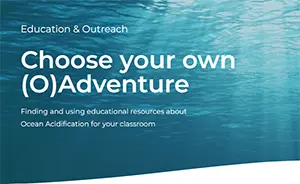
During NOAA Back to School month, OAP launched “Choose Your Own (O)Adventure,” a new interactive educational tool. It helps educators, students, and the public easily discover ocean and coastal acidification resources. Users can quickly tailor content to their specific interests, regions, species, or grade levels.
What you can do with CYOA
Explore the CYOA tool |
| |
|
OAP and mCDR research communities convene
|
| |
|
In May 2026, OAP convened two major community gatherings at the NOAA Center for Weather and Climate Prediction in College Park, MD. The triennial 2026 OAP Research Community Meeting coincided with the 15th anniversary of the program, bringing together more than 100 OAP funded researchers, coastal acidification network coordinators, and NOAA partners. The meeting focused on transitioning research into actionable decision-support tools, capturing high-frequency observing dynamics, and evaluating multi-stressor biological impacts across species and ecosystems and more.
The 2026 mCDR PI Meeting immediately followed and convened research teams funded under the FY23 multi-agency opportunity to review findings across foundational research, large-scale modeling, and coastal field trials. Discussions highlighted progress in testing marine carbon dioxide removal pathways and emphasized the critical need for continued model-observation integration, biological response studies, and robust monitoring frameworks.
|
| |
|
New guidance for fishery-sensitive mCDR
|
| |
|
MACAN releases new VR game |
|
“Water We Gonna Do?” is the newly interactive video game recently launched by the Mid-Atlantic Coastal Acidification Network (MACAN). In this interactive game, players learn about coastal acidification and explore solutions in different Mid-Atlantic coastal habitats. Investigate how planting seagrasses and wetland vegetation can help otters find more blue crabs. While designed for middle school students, it is enjoyable to all ages. Jam Jar Game Studios developed the game.
Image Credit: MACAN |
|
|
| |
|
|
|
The National Coral Reef Monitoring Program released a summary of 2021-2023 ocean acidification data published as NOAA admin report.
Image Credit: NOAA Pacific Islands Fisheries Science Center (PIFSC) |
|
|
| |
|