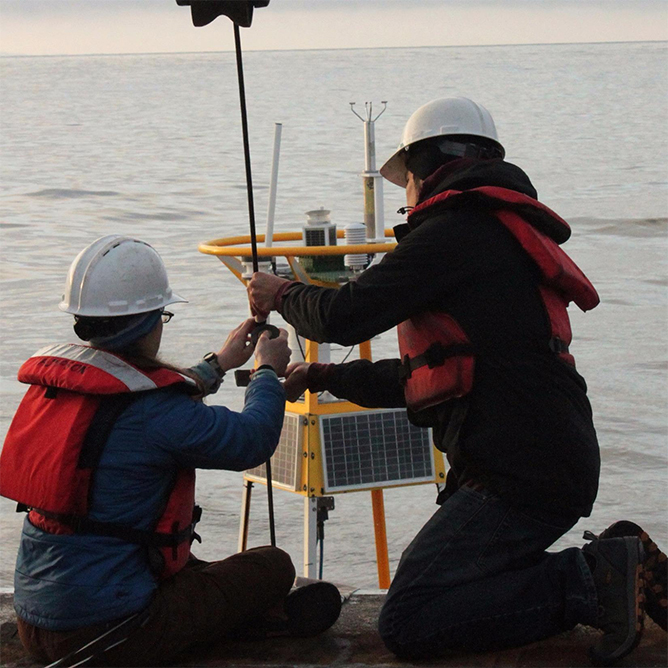
What can a buoy tell us about ocean acidification? Quite a lot, especially when it has been collecting measurements for years.
In the California Current, a slow moving southward current that moves from British Columbia to Baja California, long-term observations help scientists track how ocean conditions change over hours, seasons, and years. Since natural phenomena like upwelling and El Niño rapidly alter water chemistry, continuous observations are vital for separating short-term fluctuations from broader ocean acidification trends.
Join Scripps Institution of Oceanography (Scripps) graduate student, Charles Lindsay, at sea as the recent Ocean Time-Series group, led by Uwe Send, deploy and maintain an ocean monitoring mooring off Southern California. In Anchored in the California Current: A Buoy’s View of Ocean Oscillations, readers are taken aboard a “day in the life” look at the work behind long-term ocean observations and the effort required to keep these instruments collecting data.
Video: Mooring recovery off the California coast. Credit: Scripps Oceanography
A closer look at the California Current
Moorings are one way scientists collect sustained ocean observations, allowing them to track changing conditions over time and compare patterns across different environments. The California Current Ecosystem (CCE) moorings are one example of this approach. Located off Point Conception in Southern California, CCE-1 through CCE-4 extend across open-ocean and coastal waters, giving researchers observations from different parts of the region.
The buoys are supported by NOAA’s Global Ocean Monitoring and Observing and Ocean Acidification program, with contributions from NOAA Pacific Marine Environmental Laboratory (PMEL), NOAA Southwest Fisheries Science Center (SWFSC), National Science Foundation (NSF), Southern California Coastal Ocean Observing System (SCCOOS), and are maintained and deployed by Scripps.

These observations show when more acidic water comes closer to the surface and how long those conditions last. Looking at these changes over time can show how upwelling affects coastal waters and how often marine life experiences more acidic conditions. They also inform us about ocean carbon uptake and whether the ocean is acting as a source or sink of carbon.
The CCE moorings are also coordinated with observing efforts including California Cooperative Oceanic Fisheries Investigation(CalCOFI), The California Current Ecosystem Long Term Ecological Research (CCE-LTER), the Consortium on the Ocean’s Role in Climate (CORC) and Southern California Coastal Ocean Observing System (SCCOOS). They strengthen the broader observing network off Southern California by providing sea surface to seafloor observations of ocean chemistry, biology and physics.
“The CCE mooring network helps measure upwelling of deep, nutrient-rich water and subsequent interactions between ocean currents, chemistry, and biology.”‘
Liza Wright-Fairbanks, Environmental Research and Field Operations Manager, OAP

Why NOA-ON matters
The CCE moorings contribute to the NOAA Ocean Acidification Observing Network (NOA-ON), which supports sustained observations of ocean chemistry and related conditions across U.S. waters. These sustained observations allow researchers to detect subtle environmental shifts that periodic cruises might overlook. They also enable researchers to understand how natural variability interacts with longer-term ocean acidification and provide data that can support ocean and climate models, fisheries, aquaculture and ecosystem research.
Teamwork makes the dream work
Every successful monitoring mission relies on seamless teamwork and this mission was no exception. These efforts offer a behind-the-scenes look at how a science team communicates with the ship’s crew to coordinate the vessel’s movements and maintain steady progress. This collaboration also reached beyond the ship. By working alongside Chumash Tribal members and honoring their role as co-stewards, the mission brings together different knowledge, perspectives, and responsibilities.