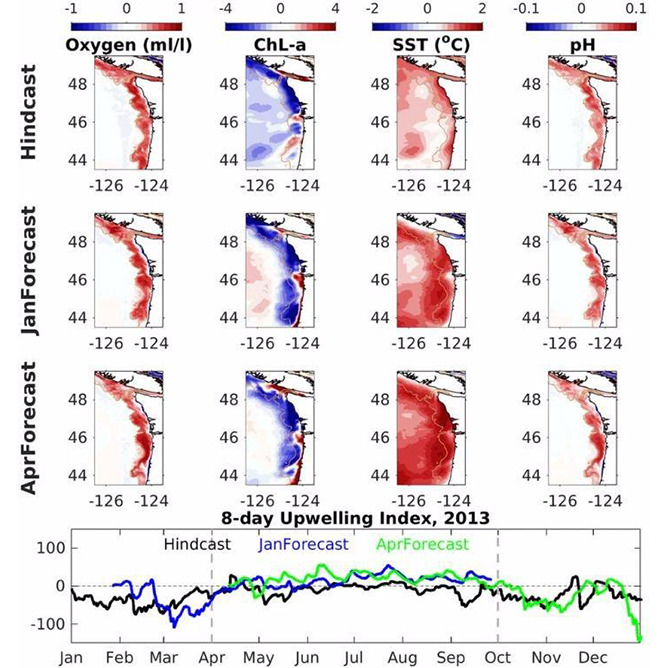
The response of marine organisms to ocean acidification depends on their adaptive capacity, which can be partially understood by evaluating the amount of existing variability in CO2 sensitivity within a species. The process of local adaptation is a mechanism that can drive variability in CO2 sensitivity. In this study, we measured the survival and molt rate of Dungeness crab Metacarcinus magister zoeae that were produced by gravid crabs collected from 3 locations in waters off of Washington State, USA, and reared in a common laboratory in ambient, medium, and high CO2 treatments. The 3 locations from which crabs were collected have different carbonate chemistry dynamics, and Dungeness crabs in these locations are to some extent genetically distinct. We hypothesized that these conditions may favor local adaptation. We did not find evidence of local adaptation, but did see different levels of CO2 sensitivity associated with the mother. This variation in CO2 sensitivity suggests an adaptive capacity that is likely to influence Dungeness crab response to future acidification.
Population and maternal variation in the sensitivity of Dungeness crab Metacarcinus magister zoeae to elevated CO2
- Paul McElhany, D. Shallin Busch, Michael Maher, Danielle Perez, Kate Rovinski
- Marine Ecology Progress Series
- May 15, 2025
Citation: McElhany, P., Busch, S., Maher, M., Perez, D., & Rovinski, K. (2025). Population and maternal variation in the sensitivity of Dungeness crab zoea (Metacarcinus magister) to elevated CO2. Marine Ecology Progress Series. https://doi.org/10.3354/meps14854