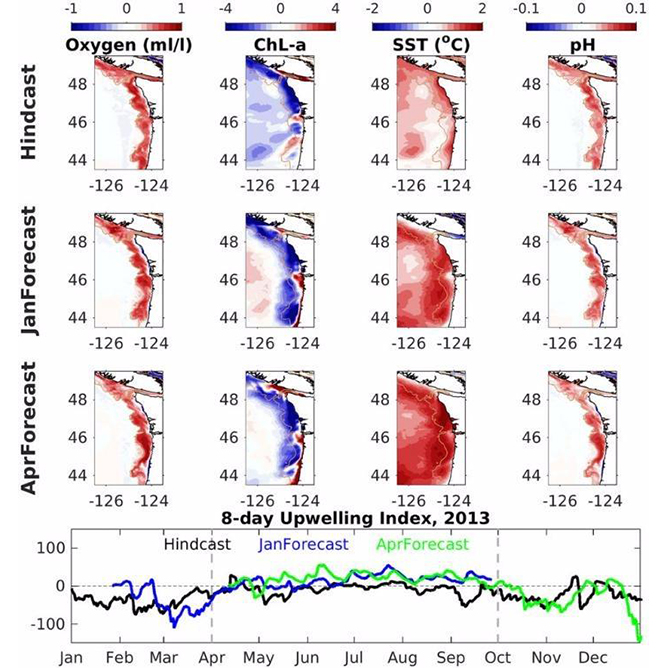
Similar to weather forecasts for the atmosphere, numerical models can also be used to forecast ocean conditions. The skill of these forecasts can be high up to several months in advance because the ocean has a relatively long memory and changes occur more slowly, particularly below the surface. The Bering Sea sustains substantial marine fisheries, which are threatened by changing ocean conditions such as increasing water acidity. Here we used an ocean model to test how well the model can forecast acidified bottom water conditions several months in advance. We did this by running a suite of reforecasts (i.e., we retroactively forecast years that have already occurred) and comparing to the model simulation of the conditions that did occur. Our results suggest that the model can generate skillful forecasts with lead times of up to 9 months, mainly because the conditions that occur at the start of our forecast tend to persist through the summer and into the fall. These forecasts can provide Bering Sea resource managers with advance warnings of water conditions that are harmful to marine species, such as Bristol Bay red king crab. Project: NRDD 20780
Seasonal Forecasts of pH and Aragonite Saturation for the Bering Sea Shelf
- Journal of Geophysical Research: Oceans
- June 30, 2026
Citation: Pilcher, D. J., Kearney, K. A., Hermann, A. J., Cheng, W., Cross, J. N., & Monacci, N. M. (2026). Seasonal forecasts of pH and aragonite saturation for the Bering Sea shelf. Journal of Geophysical Research: Oceans, 131, e2025JC023279. https://doi. org/10.1029/2025JC023279