Official websites use .gov
A .gov website belongs to an official government organization in the United States.

Secure .gov websites use HTTPS
A lock ( ) or https:// means you’ve safely connected to the .gov website. Share sensitive information only on official, secure websites.

Protecting Chesapeake Bay’s Shellfish Legacy

Delivering tools to help Chesapeake shellfish growers confront coastal acidification

Background image: a box of oysters

For Chesapeake Bay oyster and clam farmers, checking morning conditions goes beyond watching the tides. It’s also about keeping a close eye on water quality, including water chemistry. A NOAA Ocean Acidification Program (OAP)-funded project led by a team of researchers at the Virginia Institute of Marine Science (VIMS) is turning complex oceanographic data into practical, easy to understand tools for local aquaculture. At the end of the project, growers will be able to turn to a new dashboard to get nowcasts and forecasts on their screens.

Background Image: A worker in shallow water lifts a rectangular wire cage from a row of suspended aquaculture traps.

What's at Stake

Shellfish aquaculture is a vital cornerstone of the Chesapeake Bay’s coastal economy and ecosystem. In Virginia alone, direct farm sales for shellfish aquaculture reached $81M in 2024, a 52% increase from 2018. Beyond this economic success, oysters and hard clams serve as essential environmental engineers, filtering water and supporting the health of the bay.

However, ocean and coastal acidification (OCA) poses a hidden stressor. Driven globally by excess carbon dioxide and intensified locally by freshwater and nutrient runoff, OCA makes it harder for calcifying shellfish to grow and maintain their shells. In coastal estuaries, OCA rarely acts alone, compounding with other environmental shifts like temperature fluxes and nutrient runoff.

“In recent years, it has become clear that multiple correlated stressors are at play… the more I delve into this topic, the more I think this will become an unavoidable reality in the future.”
Alex Lambert
Co-Owner of Lambert Shellfish Oyster Farm & Project Advisory Committee Member
“We’re not yet seeing catastrophic shellfish hatchery crashes linked directly to OCA like in the Pacific Northwest yet. I am excited for the opportunity to get ahead of this threat to help the aquaculture industry anticipate future impacts and develop strategies to mitigate them.”
Emily Rivest
Associate Professor at VIMS and Project Lead

Background Image: A shucked oyster in a gloved hand

Bridging Science and Farming

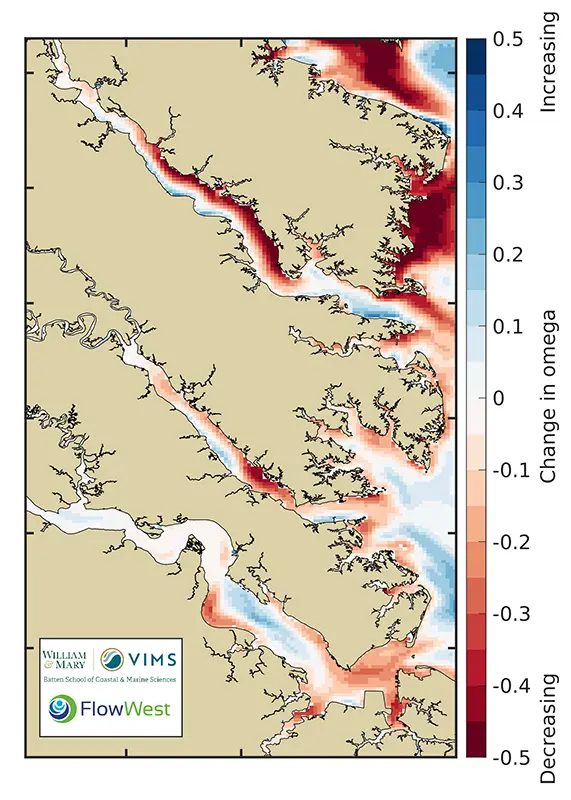
This work marks an exciting evolution in responsive regional ocean science. Building on previous work, this project incorporates higher-resolution, finer scale OCA modeling directly into the Chesapeake Bay Environmental Forecasting System (CBEFS) for a higher-resolution, interactive map of present day and future conditions. The resulting dashboard allows growers to visualize spatial risks in three ecoregions not currently included – the Western Shore, the Bayside Eastern Shore, and the Seaside Eastern Shore – and utilize interactive tools like EcoOyster and EcoClam, to predict effects on shellfish growth and survival.

“We need to be able to predict stressors on a spatial scale that matches the aquaculture industry,” says Rivest. “Our unique modeling approach combines projections of water conditions with how those conditions will influence shell growth at aquaculture lease locations throughout the Chesapeake Bay Region.”

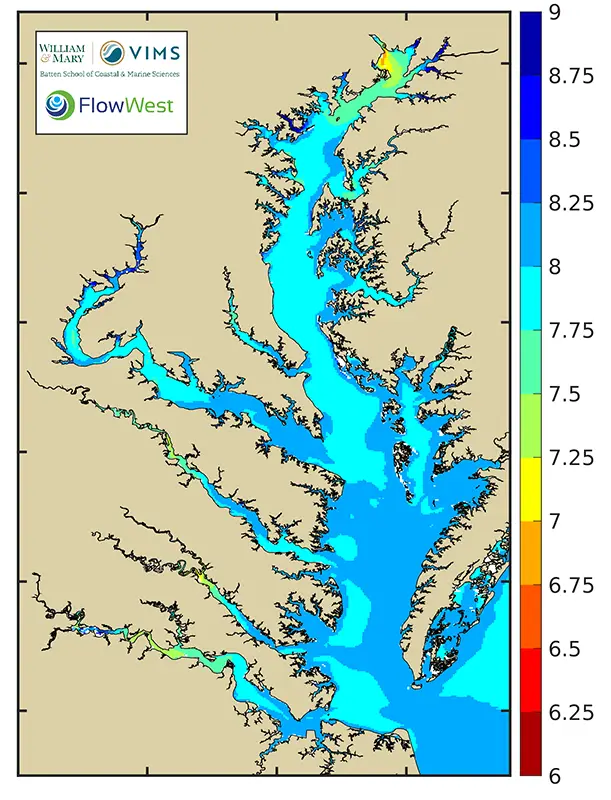
Chart of CBEFS water quality plots
Visualization of Chesapeake bay displaying surface pH
Visualization of Chesapeake bay displaying aragonite trends
“Market-ready oysters are easily stressed by environmental shifts. Using forecast data will allow us to refine both of our harvesting and processing procedures to protect the product.”
Alex Lambert
Co-Owner of Lambert Shellfish Oyster Farm & Project Advisory Committee Member

To ensure these scientific tools meet real-world needs, researchers conduct field interviews with industry and community leaders. Their insights bridge the gap between raw data and daily farm operations. Central to this effort is an active Advisory Committee of scientists, shellfish farmers, and community planners. This real-time feedback loop helps to refine the dashboard and keep the science grounded in practical, user-friendly applications.

“The goal is to provide something practical that people will actually use to help with decision-making, to know what’s coming and how they can adapt now.”
Adriane Michaelis
Assistant Professor at VIMS and project co-investigator

Background Image: Hand full of small oysters used as seeds


Preparing for the Future

This collaborative effort offers a scalable roadmap for how coastal communities can prepare for emerging environmental challenges.

“By planning forward with the insights, the industry and coastal communities will be better equipped to adapt and bounce back from future environmental challenges” says Will Isenberg, Coastal Planner at VA Coastal Zone Management Program. “The goal of this work is longer-term resilience – to be able to continue to produce and grow shellfish in our waters, and maintain the industries and local economies built on that.”

By connecting science with day-to-day decisions, the dashboard will directly inform the implementation of recommendations within the developing Virginia Ocean Plan.

Background Image:  People sitting on a dock during an aquaculture farm tour. The farmer is showing them an oyster cage.

Credits:

Background images by Amber Breitenberg. CBEFS dashboard images by VIMS.

Effects of ocean acidification and temperature on Alaskan crabs

Red King Crab
Image credit: David Csepp, NMFS AKFSC ABL

Long-term declines of red king crab in Bristol Bay, Alaska may be partially attributed to ocean acidification conditions. These impacts may be partially responsible for the fishery closures during the 2021–2022 and 2022–2023 seasons. Researchers found that ocean acidification negatively impacts Alaskan crabs generally by changing physiological processes, decreasing growth, increasing death rates and reducing shell thickness. Funded by the Ocean Acidification Program, scientists at the Alaska Fisheries Science Center continue to investigate the responses of early life history stages and study the potential of various Alaska crabs to acclimate to changing conditions. Results will inform models that will use the parameters studied to predict the effects of future ocean acidification on the populations of red king crab in Bristol Bay as well as on the fisheries that depend on them. Fishery managers will better be able to anticipate and manage stocks if changing ocean chemistry affects stock productivity and thus the maximum sustainable yield.

More about this work

Forecasts for Alaska Fisheries

Crab pots and fishing nets in Alaska's Dutch Harbor
Image credit: Michael Theberge

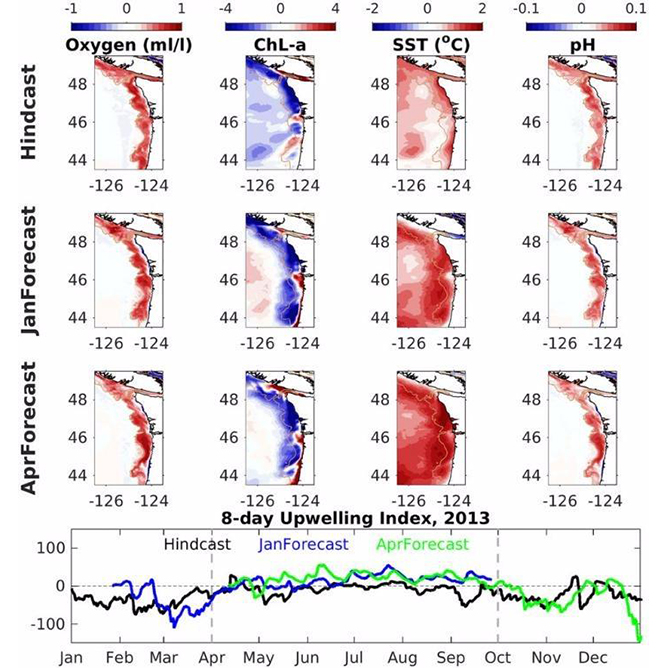
Understanding seasonal changes in ocean acidification in Alaskan waters and the potential impacts to the multi-billion-dollar fishery sector is a main priority. Through work funded by NOAA’s Ocean Acidification Program, the Pacific Marine Environmental Laboratory developed a model capable of depicting past ocean chemistry conditions for the Bering Sea and is now testing the ability of this model to forecast future conditions. This model is being used to develop an ocean acidification indicator provided to fisheries managers in the annual NOAA Eastern Bering Sea Ecosystem Status Report.

ADAPTING TO OCEAN ACIDIFICATION

The NOAA Ocean Acidification Program (OAP) works to prepare society to adapt to the consequences of ocean acidification and conserve marine ecosystems as acidification occurs. Learn more about the human connections and adaptation strategies from these efforts.

Adaptation approaches fostered by the OAP include:

FORECASTING

Using models and research to understand the sensitivity of organisms and ecosystems to ocean acidification to make predictions about the future, allowing communities and industries to prepare

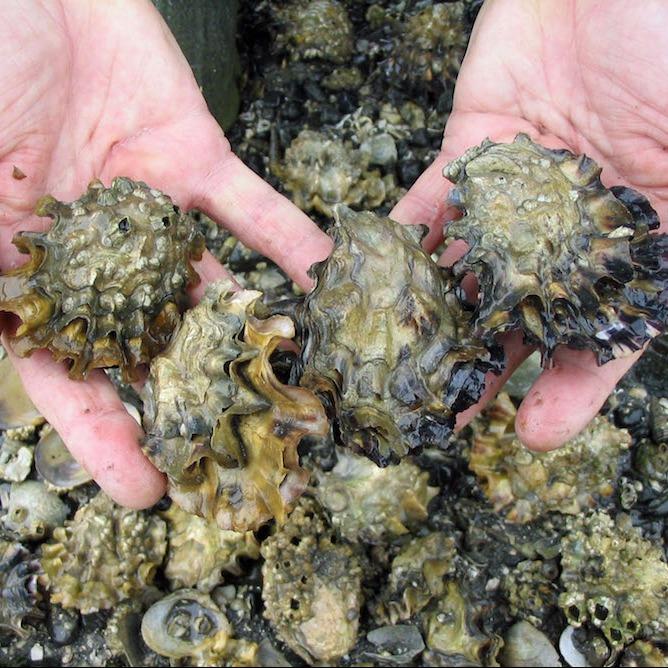
Closeup of oysters cupped in someone's hands

MANAGEMENT

Using these models and predictions as tools to facilitate management strategies that will protect marine resources and communities from future changes

TECHNOLOGY DEVELOPMENT

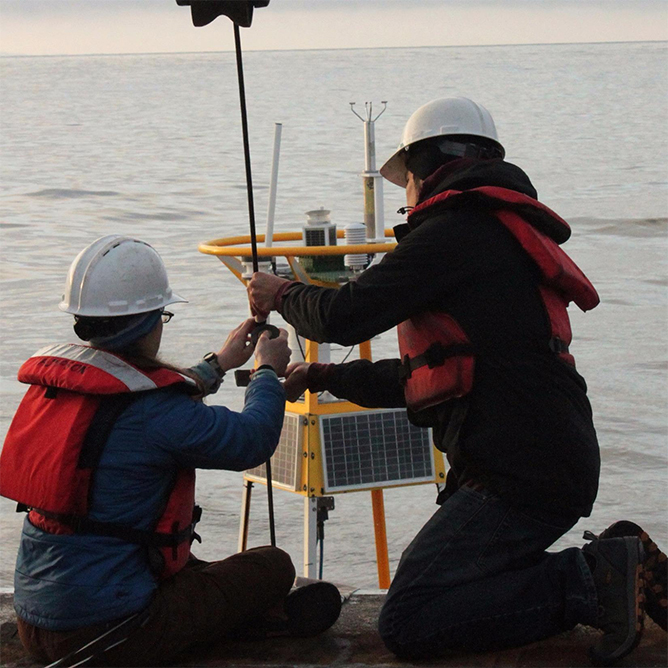
Developing innovative tools to help monitor ocean acidification and mitigate changing ocean chemistry locally

REDUCING OUR CARBON FOOTPRINT

On the Road

Drive fuel-efficient vehicles or choose public transportation. Choose your bike or walk! Don't sit idle for more than 30 seconds. Keep your tires properly inflated.

With your Food Choices

Eat local- this helps cut down on production and transport! Reduce your meat and dairy. Compost to avoid food waste ending up in the landfill

With your Food Choices

Make energy-efficient choices for your appliances and lighting. Heat and cool efficiently! Change your air filters and program your thermostat, seal and insulate your home, and support clean energy sources

By Reducing Coastal Acidification

Reduce your use of fertilizers, Improve sewage treatment and run off, and Protect and restore coastal habitats

TAKE ACTION WITH YOUR COMMUNITY

You've taken the first step to learn more about ocean acidification - why not spread this knowledge to your community?

Every community has their unique culture, economy and ecology and what’s at stake from ocean acidification may be different depending on where you live.  As a community member, you can take a larger role in educating the public about ocean acidification. Creating awareness is the first step to taking action.  As communities gain traction, neighboring regions that share marine resources can build larger coalitions to address ocean acidification.  Here are some ideas to get started:

  1. Work with informal educators, such as aquarium outreach programs and local non-profits, to teach the public about ocean acidification. Visit our Education & Outreach page to find the newest tools!
  2. Participate in habitat restoration efforts to restore habitats that help mitigate the effects of coastal acidification
  3. Facilitate conversations with local businesses that might be affected by ocean acidification, building a plan for the future.
  4. Partner with local community efforts to mitigate the driver behind ocean acidification  – excess CO2 – such as community supported agriculture, bike & car shares and other public transportation options.
  5. Contact your regional Coastal Acidification Network (CAN) to learn how OA is affecting your region and more ideas about how you can get involved in your community
       More for Taking Community Action