Addressing Ocean Acidification in a Vulnerable Region: The Alaska Ocean Acidification Network
Background image: Fishermen bring in a catch of king crabs.
Ocean acidification is a global issue, driven by absorption of carbon dioxide from the atmosphere, and it holds particular interest and concern for Alaskans. A primary reason is that Alaska water is cold, and cold water can hold more gas – just like a cold soda stays more fizzy than a warm one. This makes Alaska’s waters naturally more rich in carbon dioxide and thereby higher in acidity, placing it closer to the threshold that could be harmful to marine organisms. Since Alaska is home to a $6 billion dollar seafood industry and many communities that rely heavily on subsistence fishing, the stakes are high.
These realities were on the minds of the researchers, fishermen, coastal community members and others who helped launch the Alaska Ocean Acidification Network in 2016. The goal of the network is to expand the understanding of ocean acidification processes and consequences, as well as explore potential adaptation and mitigation efforts.
“Monitoring ocean acidification is like putting headlights on a car,” said network director Darcy Dugan. “We need to see what’s ahead of us so we can be informed and prepare. Ocean acidification is going to impact some areas more than others, and produce winners and losers among marine organisms. How can we anticipate some of these changes and help fisheries and Alaskans adapt?”
Background Image: A group making observations on the Alaskan coast.
Tracking ocean acidification takes time. Because there is a lot of natural variability in the acidity of water, data needs to be collected over a long period of time to tease out the long-term trend from the noise. The history of ocean acidification monitoring in Alaska is relatively short, but interest within the research community has picked up quickly. The University of Alaska Fairbanks opened the Ocean Acidification Research Center in 2008 to establish a baseline understanding of water chemistry around the state. By 2013, autonomous sensors were collecting data year round in the Bering Sea, Kodiak Archipelago, Resurrection Bay, and Southeast Alaska.
The Alaska Ocean Acidification Network was the fourth such network to emerge in the nation, and is now one of six spread out across the country. It is coordinated by the Alaska Ocean Observing System, a regional arm of NOAA’s Integrated Ocean Observing System (IOOS). Dugan explains, “The existing ocean acidification networks were key in helping provide ideas for what our efforts in Alaska could look like. Each region is different and has its own unique environmental influences and stakeholders, but we work together to share science, coordination strategies, and lessons learned,” Dugan explains.
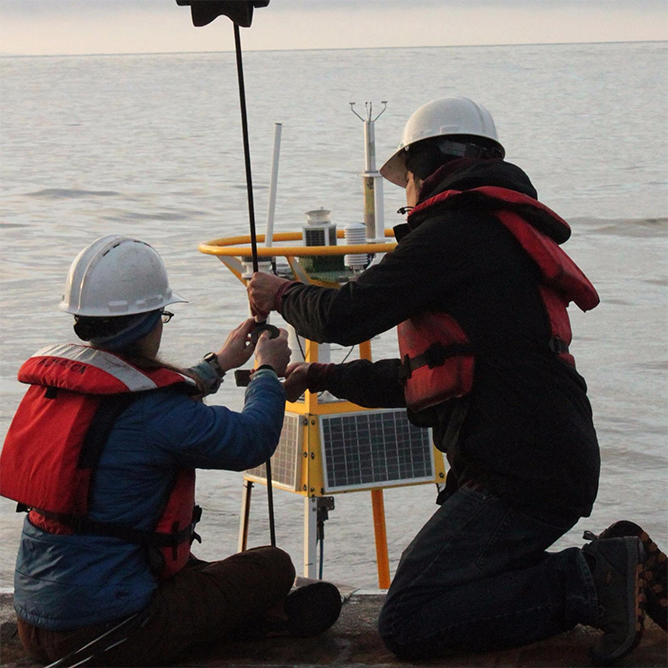
Background Image: GAKOA Buoy
In 2016, the Alaska Ocean Acidification Network spent its first year collecting input from researchers, shellfish growers, Tribal representatives, and fishermen and shaping the focus using a large interdisciplinary steering committee. At the end of the first year, they held a state-wide “State of the Science” workshop attended by 100 people in person and 150 more online where people could learn about what monitoring efforts were underway and what results were showing so far. The focused group discussions at the workshop transitioned into the network’s working groups: research and monitoring, fishing community engagement, outreach and communication, education, policy, and Tribal monitoring.
Since then, the Alaska Ocean Acidification Network has continued to build partnerships with both Tribal entities and commercial fishermen and shellfish growers; groups that depend directly on marine resources potentially at risk from ocean acidification. Through collaboration with the network, Tribal communities have developed an extensive community sampling program. Community members collect water samples and send them to one of three regional hubs to be analyzed locally.
Background Image: Bob Foy, Director of NOAA’s Alaska Fisheries Science Center
Commercial fishermen are also interested in learning about and contributing to the ocean acidification monitoring efforts in Alaska. The United Fishermen of Alaska have been an engaged partner, helping to share the latest science with their large membership. The Alaska Bering Sea Crabbers are another group invested in understanding the latest science and contributing to the dialogue and understanding of at-risk species.
The network is actively working on ideas for how to incorporate fishing vessel observations into research. There are challenges in doing this in a cost-effective way, but as technology advances and oceanographic modeling improves, these partnerships will continue to move forward.
In addition to helping expand monitoring and spread information about potential impacts to communities, the Alaska Ocean Acidification Network is also starting a new initiative to educate Alaskans on carbon policies. Because carbon dioxide emissions are the root cause of global ocean acidification, reducing carbon emissions is necessary for mitigating ocean acidification. The network is creating a 6-part podcast series to help inform Alaskans on what carbon policy is, why it’s relevant to coastal Alaskans, and how to interpret some of the legislation moving through Congress or being activated in other states or countries. Through this effort, the network will continue to be a source of objective scientific information while educating and empowering community voices throughout Alaska.
Background Image:
Credits:
Title image: Fishermen bring in a catch of king crabs, which is one of the species in Alaska that might be vulnerable to increased ocean acidification Credit: Alaska Bering Sea Crabbers Image 1: A group makes observations along the Alaska coast Image 2: One of the buoys in the Alaska Ocean Acidification Monitoring network, GAKOA, which collects CO2 and pH measurements multiple times dailly. Credit: NOAA Image 3: Bob Foy, Director of NOAA’s Alaska Fisheries Science Center aboard a commercial crab fishing vessel. Credit: Alaska Ocean Observing Network Image 4:A shellfish farm in Katchemak Bay.