Zooming in on ocean acidification: increasing resolution in regional ocean models in the Northeast US
“It is important to get a better understanding of the drivers of ocean acidification and where uncertainties lie to give us a direction on where to focus future research and observing,” says Dr. Siedlecki.
Not only will Dr. Siedlecki’s team be building a new model, but this model will evaluate the existing observing network’s ability to observe past coastal acidification trends and predict future ones with a focus on the important areas for major fisheries such as the scallop fishery. The scallop fishery in the Northeast US has a particular interest in acidification in the region as it can greatly impact scallop shell growth. The outputs from this model will be processed to create 3D maps that display variables crucial to the health of the ecosystem such as the timing of increases in acidity and other environmental changes relevant to the scallop fishery.
“It’s exciting that the community is supportive of this kind of research and our results can identify locations that need more management attention and what variables need more observational knowledge,” says Dr. Siedlecki. This project’s clear zoom into the region will be instrumental in informing fishery managers and enabling them to create plans in order to prepare for future challenges,
Project Co-Investigators include Dr. Enrique Curchitser, Rutgers, Dr. Charles Stock, NOAA GFDL, Dr. Joe Salisbury, University of New Hampshire, Dr. Alex Proussevitch, University of New Hampshire, Dr. Michael Alexander, NOAA ESRL, and Dr. Ru Morrison, NERACOOS
Credits:
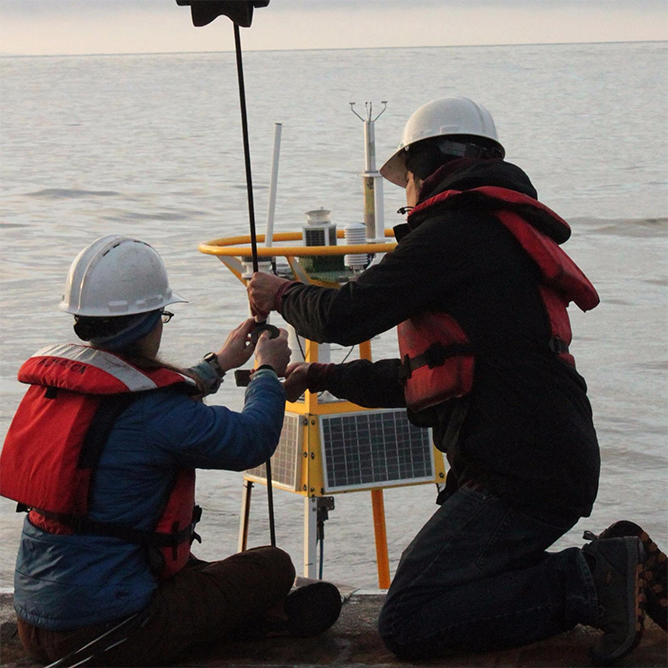
Title image by Samara Doole – “Sunset Mood,” Image 2: Arthur Mazi,- “Tokyo, 2016,” Image 3: This picture illustrates how increasing the resolution of a regional zoom represented in the inset boxes can give a more informative picture. The left of the picture shows lower resolution, similar to the current model for the northeastern Atlantic looks now, and the right displays a higher resolution image like the one Dr. Siedlecki’s team is working toward. Credit: GEOMAR Ocean Circulation and Climate Dynamics Image 4: One buoy in the National Ocean Acidification Monitoring Network Credit: NOAA Image 5: Fishing dock at dusk Credit: NOAA Northeast Fisheries Science Center