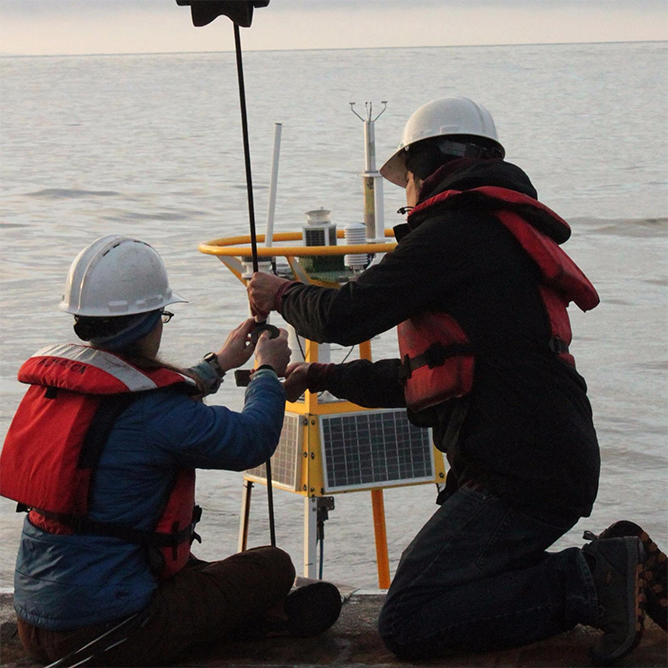
Scientists at Pacific Marine Environmental Laboratory (PMEL) and the Ocean Acidification Center at University of Alaska Fairbanks maintain four buoys in the Gulf of Alaska and Bering Sea that comprise a network to monitor ocean chemistry in sub-arctic waters. These high latitude waters are of much interest and concern because cold waters more readily absorb CO2, which causes a decrease pH and saturation state. Additionally, the predicted reduction of sea ice in this region can increase the uptake of CO2 due to 1) increased freshwater input from melt-water and rivers 2) more seawater being exposed to the atmosphere to absorb CO2 and 3) alteration of the production and decomposition of organic carbon due to increased surface area of ocean water.

Pier2Peer Alumni Showcase Webinar
Join us for a webinar showcasing research from Pier2Peer Alumni on Friday, 23 January 2026 from 12:00- 1:30 pm UTC. In this webinar, we’ll be