Official websites use .gov
A .gov website belongs to an official government organization in the United States.

Secure .gov websites use HTTPS
A lock ( ) or https:// means you’ve safely connected to the .gov website. Share sensitive information only on official, secure websites.

Monitoring & Modeling

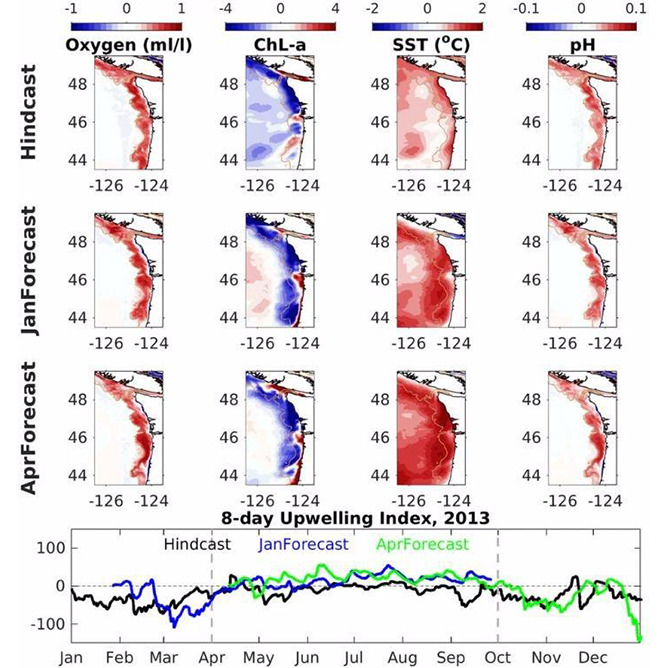
Biogeochemical Anomalies at Two Southern California Current System Moorings During the 2014–2016 Warm Anomaly-El Niño Sequence

We analyzed impacts of the 2014–2015 Pacific Warm Anomaly and 2015–2016 El Niño on physical and biogeochemical variables at two southern California Current System moorings (CCE2, nearshore upwelling off Point Conception; CCE1, offshore California Current). Nitrate and Chl-a fluorescence were <1 μM and <1 Standardized Fluorescence Unit, respectively, at CCE2 for the entire durations of the […]

Biogeochemical Anomalies at Two Southern California Current System Moorings During the 2014–2016 Warm Anomaly-El Niño Sequence Read More »

Surface ocean pH and buffer capacity: past, present and future

The ocean’s chemistry is changing due to the uptake of anthropogenic carbon dioxide (CO2). This phenomenon, commonly referred to as “Ocean Acidification”, is endangering coral reefs and the broader marine ecosystems. In this study, we combine a recent observational seawater CO2 data product, i.e., the 6th version of the Surface Ocean CO2 Atlas (1991–2018, ~23 million observations), with

Surface ocean pH and buffer capacity: past, present and future Read More »

Time of Emergence of Surface Ocean Carbon Dioxide Trends in the North American Coastal Margins in Support of Ocean Acidification Observing System Design

Time of Emergence (ToE) is the time when a signal emerges from the noise of natural variability. Commonly used in climate science for the detection of anthropogenic forcing, this concept has recently been applied to geochemical variables, to assess the emerging times of anthropogenic ocean acidification (OA), mostly in the open ocean using global climate

Time of Emergence of Surface Ocean Carbon Dioxide Trends in the North American Coastal Margins in Support of Ocean Acidification Observing System Design Read More »

Large Decadal Changes in Air-Sea CO<sub>2</sub> Fluxes in the Caribbean Sea

Through a unique collaboration with Royal Caribbean Cruise Lines several cruise ships were outfitted with automated surface water carbon dioxide (CO2) measurement systems, providing weekly observations in the Caribbean Sea over the past 16 years. From over a million measurements, the increase in surface water CO2 in response to rising atmospheric levels was accurately monitored. The region is,

Large Decadal Changes in Air-Sea CO<sub>2</sub> Fluxes in the Caribbean Sea Read More »

Global Carbon Budget 2019

Accurate assessment of anthropogenic carbon dioxide (CO2) emissions and their redistribution among the atmosphere, ocean, and terrestrial biosphere – the “global carbon budget” – is important to better understand the global carbon cycle, support the development of climate policies, and project future climate change. Here we describe data sets and methodology to quantify the five

Global Carbon Budget 2019 Read More »

A 17-year dataset of surface water fugacity of CO<sub>2</sub> along with calculated pH, aragonite saturation state and air–sea CO2 fluxes in the northern Caribbean Sea

A high-quality dataset of surface water fugacity of CO2 (fCO2w)1, consisting of over a million observations, and derived products are presented for the northern Caribbean Sea, covering the time span from 2002 through 2018. Prior to installation of automated pCO2 systems on cruise ships of Royal Caribbean International and subsidiaries, very limited surface water carbon data were available in

A 17-year dataset of surface water fugacity of CO<sub>2</sub> along with calculated pH, aragonite saturation state and air–sea CO2 fluxes in the northern Caribbean Sea Read More »

Controls on surface water carbonate chemistry along North American ocean margins

Syntheses of carbonate chemistry spatial patterns are important for predicting ocean acidification impacts, but are lacking in coastal oceans. Here, we show that along the North American Atlantic and Gulf coasts the meridional distributions of dissolved inorganic carbon (DIC) and carbonate mineral saturation state (Ω) are controlled by partial equilibrium with the atmosphere resulting in

Controls on surface water carbonate chemistry along North American ocean margins Read More »

Field evaluation of a low-powered, profiling <em>p</em>CO<sub>2</sub> system in coastal Washington

Summertime upwelling of deep, corrosive waters on the continental shelf of the northern California Current System can exacerbate ocean acidification conditions, providing unsuitable environments for development of calcifying organisms and finfish that are important to the local economy. To better understand the carbonate system in this dynamic region, two recently developed technologies were combined with

Field evaluation of a low-powered, profiling <em>p</em>CO<sub>2</sub> system in coastal Washington Read More »

Ocean and coastal indicators: understanding and coping with climate change at the land-sea interface

The U.S. Exclusive Economic Zone (EEZ) encompasses approximately 3.4 million square nautical miles of ocean and a coastline of over 12,300 miles. Along with the Great Lakes, this vast area generates ~US 370 billion of U.S. gross domestic product, 617 billion in sales and 2.6 million jobs each year. These ocean and coastal ecosystems also

Ocean and coastal indicators: understanding and coping with climate change at the land-sea interface Read More »

Subsurface automated samplers (SAS) for ocean acidification research

Ocean acidification (OA) is the process whereby anthropogenic carbon dioxide is absorbed into seawater, resulting in altered carbonate chemistry and a decline in pH. OA will negatively impact numerous marine organisms, altering the structure and function of entire ecosystems. The progression of OA, while faster than has occurred in recent geological history, has been subtle

Subsurface automated samplers (SAS) for ocean acidification research Read More »

Forecasts for Alaska Fisheries

Crab pots and fishing nets in Alaska's Dutch Harbor
Image credit: Michael Theberge

Understanding seasonal changes in ocean acidification in Alaskan waters and the potential impacts to the multi-billion-dollar fishery sector is a main priority. Through work funded by NOAA’s Ocean Acidification Program, the Pacific Marine Environmental Laboratory developed a model capable of depicting past ocean chemistry conditions for the Bering Sea and is now testing the ability of this model to forecast future conditions. This model is being used to develop an ocean acidification indicator provided to fisheries managers in the annual NOAA Eastern Bering Sea Ecosystem Status Report.

ADAPTING TO OCEAN ACIDIFICATION

The NOAA Ocean Acidification Program (OAP) works to prepare society to adapt to the consequences of ocean acidification and conserve marine ecosystems as acidification occurs. Learn more about the human connections and adaptation strategies from these efforts.

Adaptation approaches fostered by the OAP include:

FORECASTING

Using models and research to understand the sensitivity of organisms and ecosystems to ocean acidification to make predictions about the future, allowing communities and industries to prepare

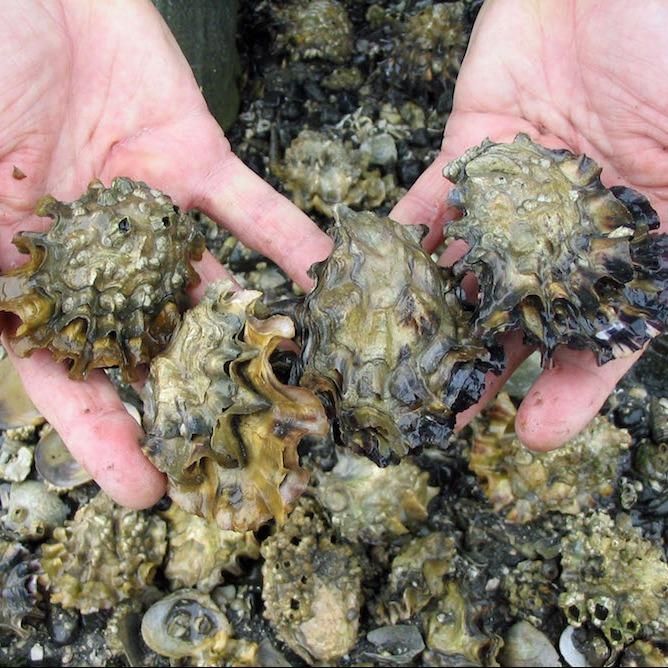
Closeup of oysters cupped in someone's hands

MANAGEMENT

Using these models and predictions as tools to facilitate management strategies that will protect marine resources and communities from future changes

TECHNOLOGY DEVELOPMENT

Developing innovative tools to help monitor ocean acidification and mitigate changing ocean chemistry locally

REDUCING OUR CARBON FOOTPRINT

On the Road

Drive fuel-efficient vehicles or choose public transportation. Choose your bike or walk! Don't sit idle for more than 30 seconds. Keep your tires properly inflated.

With your Food Choices

Eat local- this helps cut down on production and transport! Reduce your meat and dairy. Compost to avoid food waste ending up in the landfill

With your Food Choices

Make energy-efficient choices for your appliances and lighting. Heat and cool efficiently! Change your air filters and program your thermostat, seal and insulate your home, and support clean energy sources

By Reducing Coastal Acidification

Reduce your use of fertilizers, Improve sewage treatment and run off, and Protect and restore coastal habitats

TAKE ACTION WITH YOUR COMMUNITY

You've taken the first step to learn more about ocean acidification - why not spread this knowledge to your community?

Every community has their unique culture, economy and ecology and what’s at stake from ocean acidification may be different depending on where you live.  As a community member, you can take a larger role in educating the public about ocean acidification. Creating awareness is the first step to taking action.  As communities gain traction, neighboring regions that share marine resources can build larger coalitions to address ocean acidification.  Here are some ideas to get started:

  1. Work with informal educators, such as aquarium outreach programs and local non-profits, to teach the public about ocean acidification. Visit our Education & Outreach page to find the newest tools!
  2. Participate in habitat restoration efforts to restore habitats that help mitigate the effects of coastal acidification
  3. Facilitate conversations with local businesses that might be affected by ocean acidification, building a plan for the future.
  4. Partner with local community efforts to mitigate the driver behind ocean acidification  – excess CO2 – such as community supported agriculture, bike & car shares and other public transportation options.
  5. Contact your regional Coastal Acidification Network (CAN) to learn how OA is affecting your region and more ideas about how you can get involved in your community
       More for Taking Community Action