Official websites use .gov
A .gov website belongs to an official government organization in the United States.

Secure .gov websites use HTTPS
A lock ( ) or https:// means you’ve safely connected to the .gov website. Share sensitive information only on official, secure websites.

Projects

The Northeast Coastal Acidification Network: A Force for Ocean Acidification Coordination

“We need to do this in the Northeast!”
Dwight Gledhill, Deputy Director of NOAA’s Ocean Acidification Program, and Ru Morrison, Executive Director of Northeastern Regional Association of Coastal Ocean Observing Systems (NERACOOS), exclaimed after listening to a presentation on the newly formed California Current Acidification Network. Seeing how the West Coast was creating a collaboration of scientists, industry members, and managers on the West Coast inspired them to start a similar effort on the other side of the country in the Northeast US.

The Northeast Coastal Acidification Network: A Force for Ocean Acidification Coordination Read More »

Addressing Ocean Acidification in a Vulnerable Region: The Alaska Ocean Acidification Network

Ocean acidification is a global issue, driven by absorption of carbon dioxide from the atmosphere, and it holds particular interest and concern for Alaskans. A primary reason is that Alaska water is cold, and cold water can hold more gas – just like a cold soda stays more fizzy than a warm one. This makes Alaska’s waters naturally more rich in carbon dioxide and thereby higher in acidity, placing it closer to the threshold that could be harmful to marine organisms. Since Alaska is home to a $6 billion dollar seafood industry and many communities that rely heavily on subsistence fishing, the stakes are high.

Addressing Ocean Acidification in a Vulnerable Region: The Alaska Ocean Acidification Network Read More »

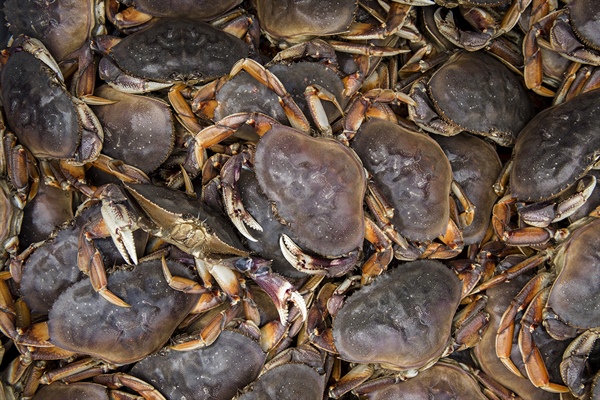
Dungeness crab in a crab hold

Assessing Community Vulnerability to Ocean Acidification Across the California Current Ecosystem

West Coast stakeholders, including fishers and shellfish farmers reliant on key economically and culturally important species, have already experienced adverse consequences of ocean acidification (OA and other stressors. However, the human dimension of vulnerability and people’s capacity to adapt, particularly in highly resource-dependent economies, remains understudied. In times of changing ocean conditions, high levels of dependence on natural resources expose certain coastal communities to higher risks and vulnerability. Achieving healthy ocean ecosystems and coastal economies in state and federal waters requires cross-disciplinary work to understand what factors (environmental, economic, social, cultural) determine the vulnerability of coastal communities to environmental change, as well as the potential for developing strategies to adapt to these changes. People’s adaptive capacity in the face of environmental disturbance depends on community knowledge, networks, and practices, as well as institutional policies and strategies that support adaptation. This project will assess how 6 coastal communities in Oregon and California are experiencing environmental vulnerability to OA and what they are doing to adapt to OA and associated impacts; as well as evaluate barriers to and key factors for coping in different contexts that can help inform policies to foster and support more resilient communities.The overarching goals of this project are to fill knowledge gaps about the vulnerability and adaptive capacity of coastal communities to OA and other environmental stressors in order to a)support thriving and resilient coastal communities along the U.S. West Coast and b) to support OA policy and decision-making at the state level of governance.

Assessing Community Vulnerability to Ocean Acidification Across the California Current Ecosystem Read More »

Understanding the vulnerability of shellfish hatcheries in the Chesapeake Bay to acidification

Acidification in brackish estuarine environments, such as the Chesapeake Bay, is intensified by coastal inputs such as runoff, atmospheric pollution and freshwater sources. The Chesapeake Bay is home to commercial shellfish hatcheries that supply seed that is sold to and planted in hundreds of shellfish farms within the Chesapeake. A great deal of research has been dedicated to understanding the impact of acidification on shellfish, and has shown even greater impacts to shellfish growth and survival in lower salinity and nutrient-rich environments. The shellfish industry relies on consistent hatchery production to sustain and expand operations that could greatly benefit from regional OA forecasts and metrics. This project will synthesize recent CO2 system observations with long-term water quality parameters and combine observations an existing baywide, high-resolution 3D model. The proposed research will develop forecasts of acidification and develop acidification metrics tailored to support decision-making needs of commercial shellfish hatchery and nursery operators.

Understanding the vulnerability of shellfish hatcheries in the Chesapeake Bay to acidification Read More »

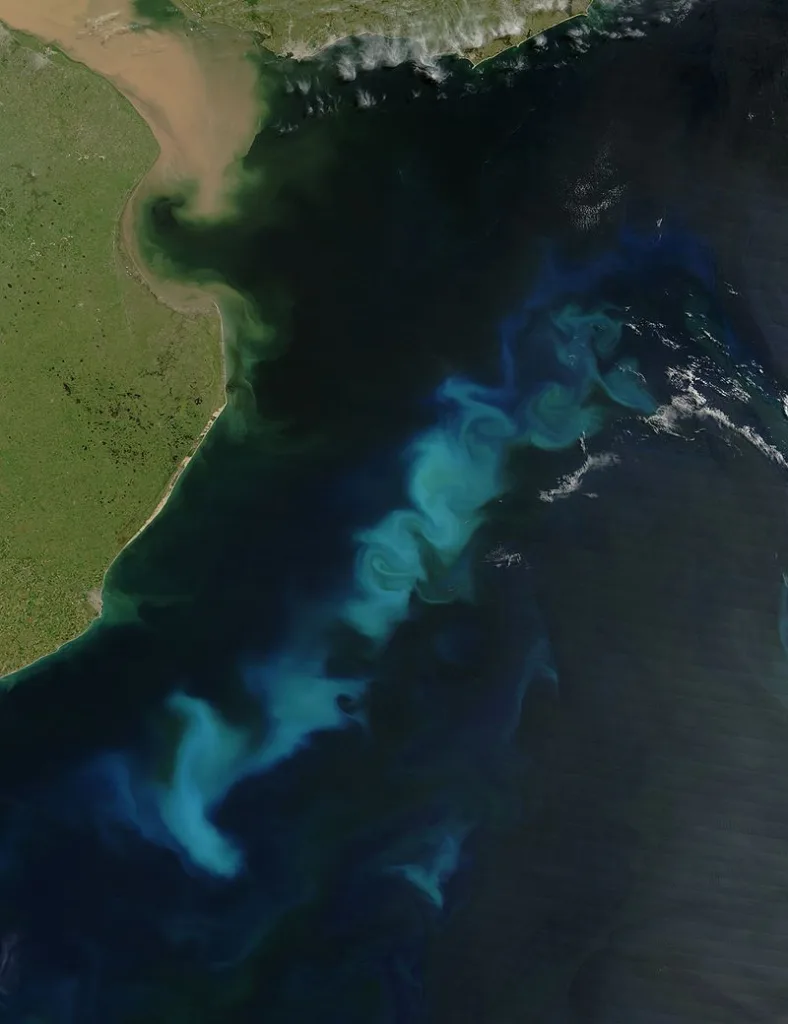
Satellite view of the Mississippi River plume in the Gulf of America. You can see sediment discharging into the Gulf. Credit: NASA

Ocean Acidification at a Crossroad– Enhanced Respiration,Upwelling, Increasing Atmospheric CO2, and their interactions in the northwestern Gulf of America

Among the NOAA designated Large Marine Ecosystems, the Gulf
of Mexico (GOM) remains poorly understood in terms of its current OA conditions, despite its
ecological and economic significance. In the northwestern GOM (nwGOM), decadal
acidification has been observed in the shelf-slope region, with metabolic production of CO2
contributing to a larger fraction of CO2 accumulation than uptake of anthropogenic CO2, and the
observed rate of acidification is significantly greater than that in other tropical and subtropical
areas. Unfortunately, whether the observed OA in this region represents a short-term
phenomenon or a long-term trend is unknown.
It is hypothesized that increasing atmospheric CO2, increasing terrestrial nutrient export
due to an enhanced hydrological cycle, and enhanced upwelling due to climate change will cause
the continental shelf-slope region in the nwGOM to acidify faster than other tropical and
subtropical seas. In order to test this hypothesis wave gliders, in -stiu sensor along withe underway measurements from research vessels will measure carbonated chemistry in in surface and shallow  waters. Modeling will be used tp integrate the chemical signals into the models to hindcast/predict spatia; and temporal variation of the OA signal for the the optimization of monitoring design and implementation.

Ocean Acidification at a Crossroad– Enhanced Respiration,Upwelling, Increasing Atmospheric CO2, and their interactions in the northwestern Gulf of America Read More »

Forecasts for Alaska Fisheries

Crab pots and fishing nets in Alaska's Dutch Harbor
Image credit: Michael Theberge

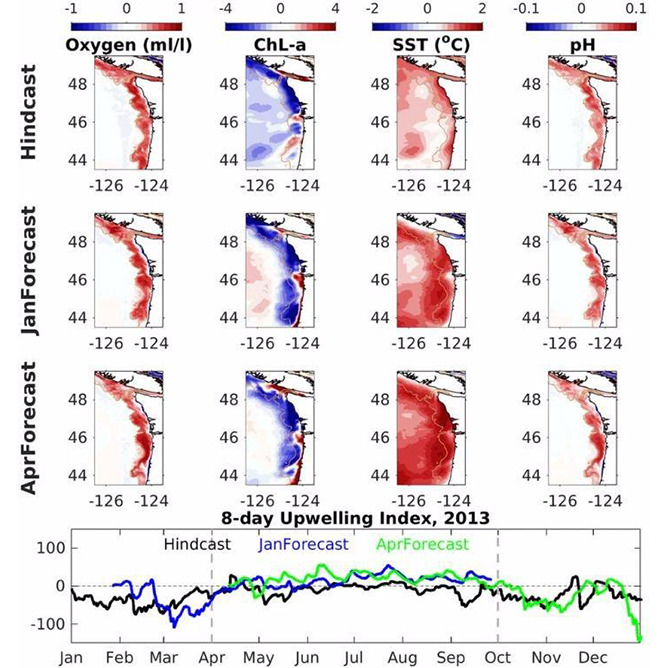
Understanding seasonal changes in ocean acidification in Alaskan waters and the potential impacts to the multi-billion-dollar fishery sector is a main priority. Through work funded by NOAA’s Ocean Acidification Program, the Pacific Marine Environmental Laboratory developed a model capable of depicting past ocean chemistry conditions for the Bering Sea and is now testing the ability of this model to forecast future conditions. This model is being used to develop an ocean acidification indicator provided to fisheries managers in the annual NOAA Eastern Bering Sea Ecosystem Status Report.

ADAPTING TO OCEAN ACIDIFICATION

The NOAA Ocean Acidification Program (OAP) works to prepare society to adapt to the consequences of ocean acidification and conserve marine ecosystems as acidification occurs. Learn more about the human connections and adaptation strategies from these efforts.

Adaptation approaches fostered by the OAP include:

FORECASTING

Using models and research to understand the sensitivity of organisms and ecosystems to ocean acidification to make predictions about the future, allowing communities and industries to prepare

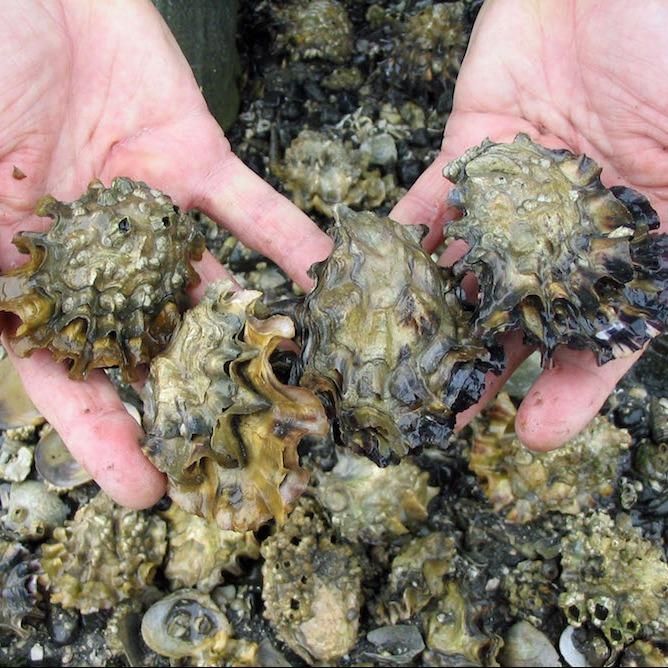
Closeup of oysters cupped in someone's hands

MANAGEMENT

Using these models and predictions as tools to facilitate management strategies that will protect marine resources and communities from future changes

TECHNOLOGY DEVELOPMENT

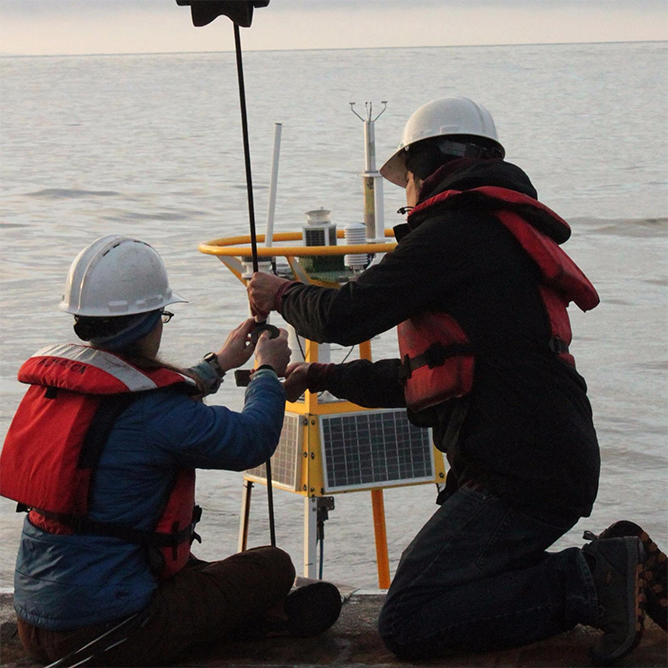
Developing innovative tools to help monitor ocean acidification and mitigate changing ocean chemistry locally

REDUCING OUR CARBON FOOTPRINT

On the Road

Drive fuel-efficient vehicles or choose public transportation. Choose your bike or walk! Don't sit idle for more than 30 seconds. Keep your tires properly inflated.

With your Food Choices

Eat local- this helps cut down on production and transport! Reduce your meat and dairy. Compost to avoid food waste ending up in the landfill

With your Food Choices

Make energy-efficient choices for your appliances and lighting. Heat and cool efficiently! Change your air filters and program your thermostat, seal and insulate your home, and support clean energy sources

By Reducing Coastal Acidification

Reduce your use of fertilizers, Improve sewage treatment and run off, and Protect and restore coastal habitats

TAKE ACTION WITH YOUR COMMUNITY

You've taken the first step to learn more about ocean acidification - why not spread this knowledge to your community?

Every community has their unique culture, economy and ecology and what’s at stake from ocean acidification may be different depending on where you live.  As a community member, you can take a larger role in educating the public about ocean acidification. Creating awareness is the first step to taking action.  As communities gain traction, neighboring regions that share marine resources can build larger coalitions to address ocean acidification.  Here are some ideas to get started:

  1. Work with informal educators, such as aquarium outreach programs and local non-profits, to teach the public about ocean acidification. Visit our Education & Outreach page to find the newest tools!
  2. Participate in habitat restoration efforts to restore habitats that help mitigate the effects of coastal acidification
  3. Facilitate conversations with local businesses that might be affected by ocean acidification, building a plan for the future.
  4. Partner with local community efforts to mitigate the driver behind ocean acidification  – excess CO2 – such as community supported agriculture, bike & car shares and other public transportation options.
  5. Contact your regional Coastal Acidification Network (CAN) to learn how OA is affecting your region and more ideas about how you can get involved in your community
       More for Taking Community Action