Official websites use .gov
A .gov website belongs to an official government organization in the United States.

Secure .gov websites use HTTPS
A lock ( ) or https:// means you’ve safely connected to the .gov website. Share sensitive information only on official, secure websites.

Celebrating 15 Years of NOAA's Ocean Acidification Program

Observing the invisible challenge

NOAA Ship Ronald H. Brown during the 2021 West Coast Ocean Acidification (NOAA)

We are now better equipped to assess and address vulnerabilities facing our coastal economies. Ocean acidification solutions rely on a strong understanding of where, when, and how fast ocean acidification occurs in U.S. waters. The first and most essential task is to track the invisible changes in our ocean that drive impacts on our natural resources and ecosystems upon which we rely from ocean surface to seafloor.

Over the past 15 years, OAP built an expansive observing network, deploying observing technologies deployed on moorings, ship-based surveys, and autonomous vehicles that span from our coasts to the Great Lakes. There is also a robust Ocean Carbon and Acidification Data System designed to make data and models freely available.

Highlights

  • 15 Moorings in 15 Years: Deployed across U.S. Large Marine Ecosystems to track and understand where and how fast ocean chemistry is changing and provide near real-time data.
  • Coast-wide research cruises: Completed 18 regional research missions to establish foundational benchmarks for ocean and coral reef health and regional research from the highest quality data.
  • Open data access: Powered by the Ocean Carbon and Acidification Data System (OCADS) to ensure data and models are freely available for research and management.
  • Advanced forecasting and modeling: OAP combines annual indicators, long-term trends, gap-filling models, and early warning seasonal forecasts to provide actionable predictions for fisheries and policymakers.
  • Technological innovation: OAP expands ocean observing coverage and resolution through testing and deployment of autonomous sensors and platforms.

Key Insight: By partnering with NOAA labs and fisheries science centers, academic partners, and state agencies, there now are standardized, reliable data that serve as a benchmark for understanding the status of ocean health.

Background Image: 

Coast-wide research cruises provide the highest quality observations that serve as benchmarks for research and other ocean observing in the region. OAP has conducted 18 regional, coast-wide research cruises, averaging one mission every four years in each region.

Check out the most recent coast-wide coastal research cruises in 2026

OAP leverages other ship-based efforts with NOAA’s fisheries and ecological monitoring surveys, the private sector through ships of opportunity, and coordinated regional and state-level efforts to expand spatial and temporal ocean observing. The annual National Coral Reef Monitoring Program (NCRMP) surveys also measure ocean chemistry and provide ‘carbonate budgets’ to compare to coral reef monitoring as part of the effort to assess ocean acidification as a driver of coral reef health.

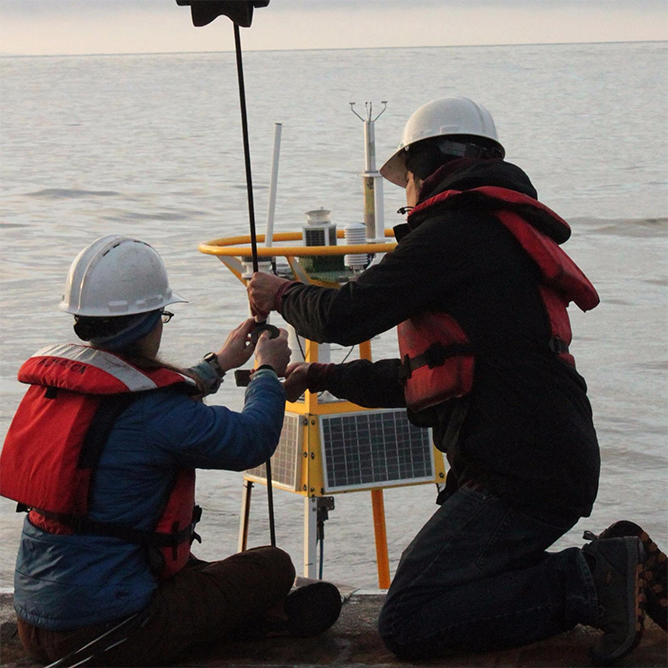
In addition to these foundational research missions, our observing is evolving from traditional ship measurements to autonomous technologies. Novel autonomous sensors and platforms, as well as low cost sensors, are being tested in different habitats to enhance monitoring.

Image: MAPCO2 monitoring buoy in Fagatele Bay, American Samoa. (Jeff Milisen, NOAA PIFSC)

NOAA Ocean Acidification Observing Network
(NOA-ON)

15 moorings in 15 years

OAP built a network of 15 moorings across the U.S. Large Marine Ecosystems that provide near real-time data to users. Most moorings use the Moored Autonomous pCO2 (MAPCO2®) system and other sensors to collect high-quality data as part of observing efforts in coastal and coral reef waters. Additionally, there is also continuous monitoring in the Great Lakes to determine the extent and effects of acidification. In preparation for updating technologies, OAP supports the development of new technologies to eventually replace the MAPCO2 system as it reaches obsolescence. NOAA built the Ocean Carbon and Acidification Data System (OCADS) to make OA data accessible and well-curated.

Key insight: With many nodes in service for more than a decade, researchers and managers are able to evaluate trends in ocean acidification that can inform mitigation and adaptation strategies.

(Adobe Stock)

Forecasting acidification

Since we cannot measure the entire ocean all the time, modeling fills in the gaps using the strategic, existing observing network. OAP has advanced four essential tools to understand and manage ocean acidification.

Indicators track our ocean’s vital signs

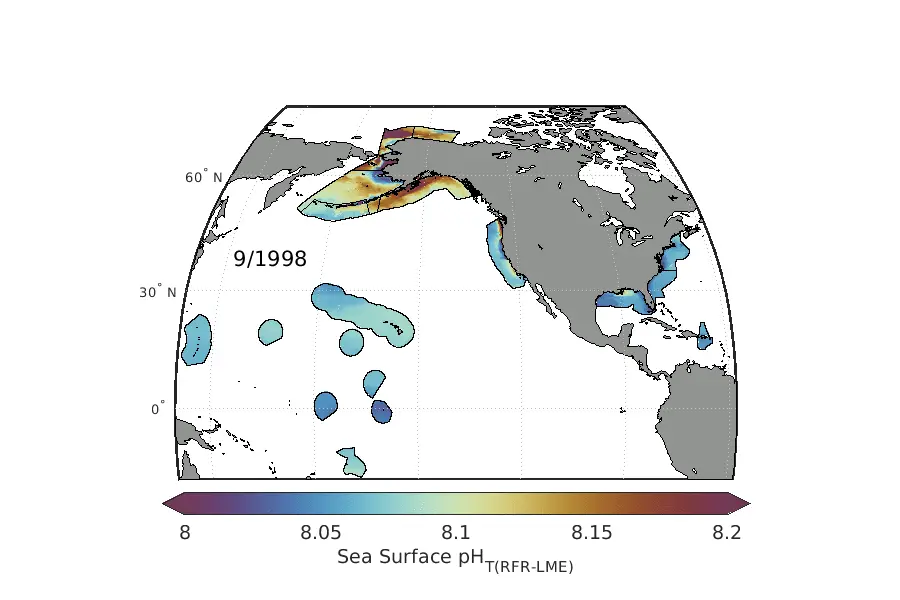
The specific measurements of ocean acidification like pH act as the baseline metrics for our ocean ecosystems. We now have annually updated indicators for our U.S. marine ecosystems.

Trends provide the big picture

Tracking indicators over decades reveals the long-term direction and speed of changing ocean chemistry. Trends move us from a snapshot of OA to a historical record.

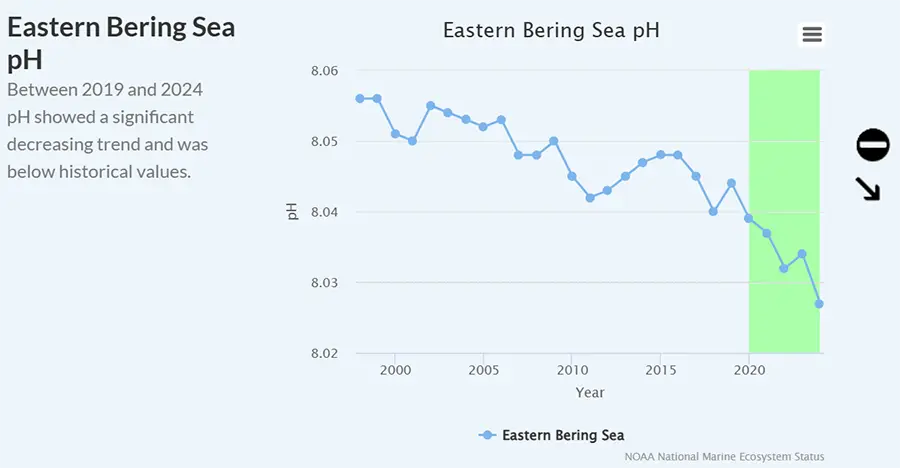
NaMES snapshot showing a decreasing pH trend
NaMES snapshot showing trend for Surface pH is a common way to quantify ocean acidification. Here, we see the past five years shows a significant decreasing trend in pH, which indicates that OA is increasing.

Models fill the gaps

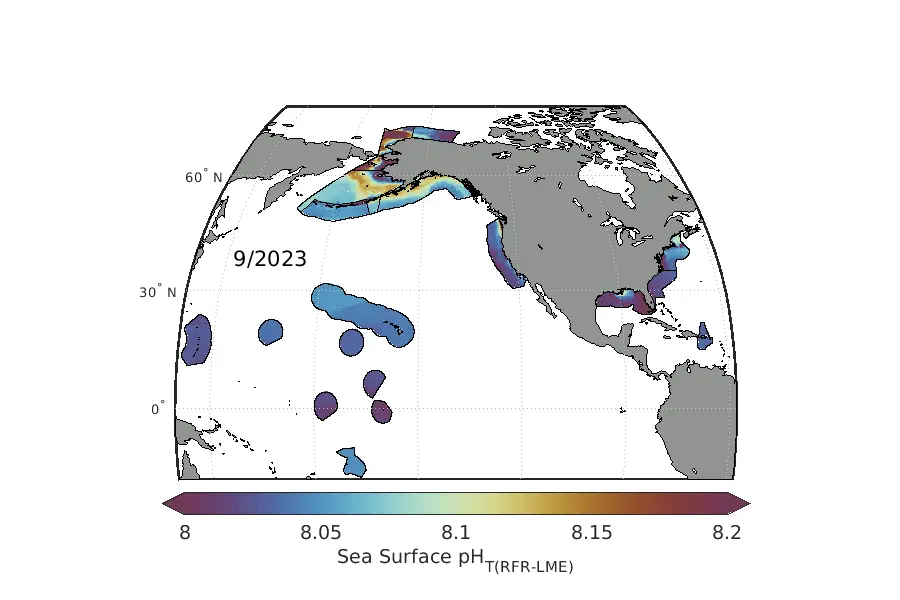
The ocean is a big place and we cannot sample all of it. Models use strategically collected existing data and trends to fill in the gaps where we cannot measure to provide a continuous map of OA. Robust monitoring and advanced research in modeling now provide significantly more accurate models than 15 years ago.

Forecasts provide an early warning system

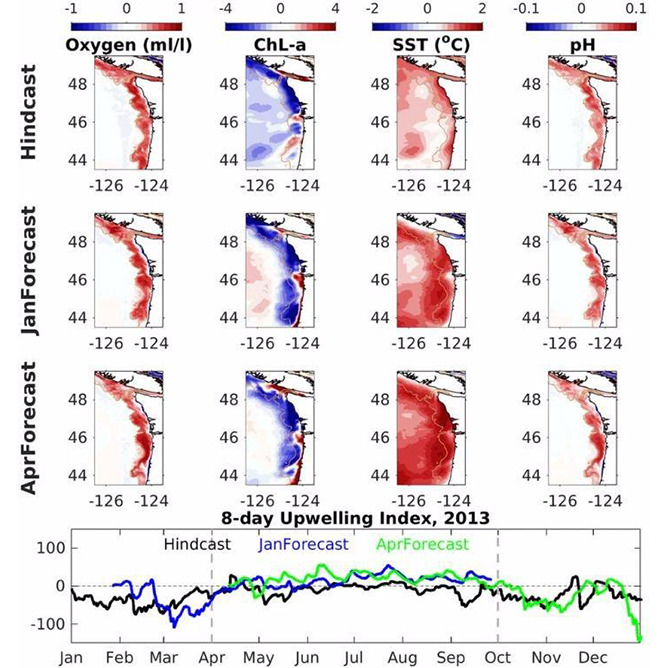
By projecting these models into the future, forecasts provide advanced notice on OA conditions. Forecasts give communities, fisheries, and policymakers the time they need to take action to protect our marine resources and coastal economies.

Seasonal forecasts on the West Coast with J-SCOPE
OA Visualization from the Chesapeake Bay Environmental Forecasting System
Chesapeake Bay Environmental Forecast System (CBEFS)

How Chesapeake Bay anglers use CBEFS to outsmart “bad water”

Key insight: We are moving beyond documenting ocean chemistry to forecasting it. By expanding our long-term monitoring reach and approaches, we provide coastal industries and communities with the real-time predictions they need to safeguard their economic future.

Bioeconomic modeling to inform Alaska fisheries management

Fishing Dock in Juneau Alaska
Image credit: Allen Shimada, NOAA NMFS

Bioeconomic models are a multidisciplinary tool that use oceanography, fisheries science and social science to assess socioeconomic impacts. Funded by the Ocean Acidification Program, researchers at the Alaska Fisheries Science Center use a bioeconomic model to study the impacts of ocean acidification on Eastern Bering Sea crab, northern rock sole and Alaska cod. The goal is to predict how ocean acidification will affect abundance yields and income generated by the fisheries. This work informs the potential economic impacts of ocean acidification and future decision making and research planning.

More about this work

Effects of ocean acidification and temperature on Alaskan crabs

Red King Crab
Image credit: David Csepp, NMFS AKFSC ABL

Long-term declines of red king crab in Bristol Bay, Alaska may be partially attributed to ocean acidification conditions. These impacts may be partially responsible for the fishery closures during the 2021–2022 and 2022–2023 seasons. Researchers found that ocean acidification negatively impacts Alaskan crabs generally by changing physiological processes, decreasing growth, increasing death rates and reducing shell thickness. Funded by the Ocean Acidification Program, scientists at the Alaska Fisheries Science Center continue to investigate the responses of early life history stages and study the potential of various Alaska crabs to acclimate to changing conditions. Results will inform models that will use the parameters studied to predict the effects of future ocean acidification on the populations of red king crab in Bristol Bay as well as on the fisheries that depend on them. Fishery managers will better be able to anticipate and manage stocks if changing ocean chemistry affects stock productivity and thus the maximum sustainable yield.

More about this work

Forecasts for Alaska Fisheries

Crab pots and fishing nets in Alaska's Dutch Harbor
Image credit: Michael Theberge

Understanding seasonal changes in ocean acidification in Alaskan waters and the potential impacts to the multi-billion-dollar fishery sector is a main priority. Through work funded by NOAA’s Ocean Acidification Program, the Pacific Marine Environmental Laboratory developed a model capable of depicting past ocean chemistry conditions for the Bering Sea and is now testing the ability of this model to forecast future conditions. This model is being used to develop an ocean acidification indicator provided to fisheries managers in the annual NOAA Eastern Bering Sea Ecosystem Status Report.

ADAPTING TO OCEAN ACIDIFICATION

The NOAA Ocean Acidification Program (OAP) works to prepare society to adapt to the consequences of ocean acidification and conserve marine ecosystems as acidification occurs. Learn more about the human connections and adaptation strategies from these efforts.

Adaptation approaches fostered by the OAP include:

FORECASTING

Using models and research to understand the sensitivity of organisms and ecosystems to ocean acidification to make predictions about the future, allowing communities and industries to prepare

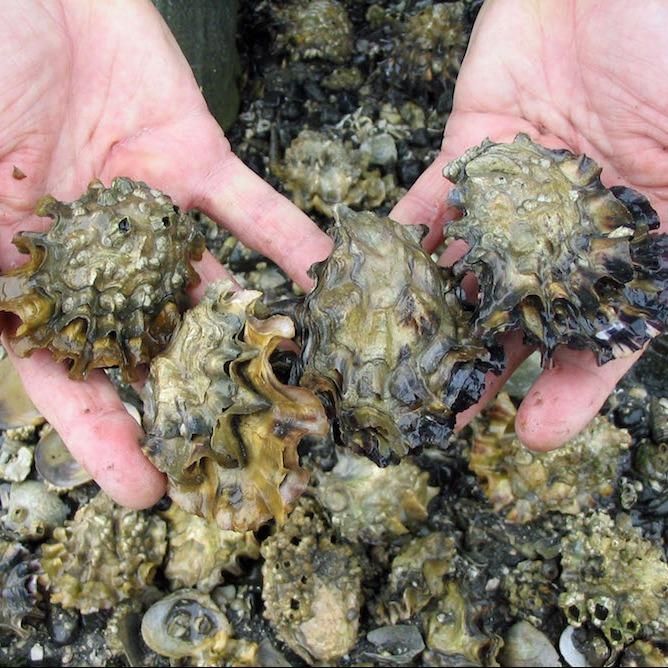
Closeup of oysters cupped in someone's hands

MANAGEMENT

Using these models and predictions as tools to facilitate management strategies that will protect marine resources and communities from future changes

TECHNOLOGY DEVELOPMENT

Developing innovative tools to help monitor ocean acidification and mitigate changing ocean chemistry locally

REDUCING OUR CARBON FOOTPRINT

On the Road

Drive fuel-efficient vehicles or choose public transportation. Choose your bike or walk! Don't sit idle for more than 30 seconds. Keep your tires properly inflated.

With your Food Choices

Eat local- this helps cut down on production and transport! Reduce your meat and dairy. Compost to avoid food waste ending up in the landfill

With your Food Choices

Make energy-efficient choices for your appliances and lighting. Heat and cool efficiently! Change your air filters and program your thermostat, seal and insulate your home, and support clean energy sources

By Reducing Coastal Acidification

Reduce your use of fertilizers, Improve sewage treatment and run off, and Protect and restore coastal habitats

TAKE ACTION WITH YOUR COMMUNITY

You've taken the first step to learn more about ocean acidification - why not spread this knowledge to your community?

Every community has their unique culture, economy and ecology and what’s at stake from ocean acidification may be different depending on where you live.  As a community member, you can take a larger role in educating the public about ocean acidification. Creating awareness is the first step to taking action.  As communities gain traction, neighboring regions that share marine resources can build larger coalitions to address ocean acidification.  Here are some ideas to get started:

  1. Work with informal educators, such as aquarium outreach programs and local non-profits, to teach the public about ocean acidification. Visit our Education & Outreach page to find the newest tools!
  2. Participate in habitat restoration efforts to restore habitats that help mitigate the effects of coastal acidification
  3. Facilitate conversations with local businesses that might be affected by ocean acidification, building a plan for the future.
  4. Partner with local community efforts to mitigate the driver behind ocean acidification  – excess CO2 – such as community supported agriculture, bike & car shares and other public transportation options.
  5. Contact your regional Coastal Acidification Network (CAN) to learn how OA is affecting your region and more ideas about how you can get involved in your community
       More for Taking Community Action