Official websites use .gov
A .gov website belongs to an official government organization in the United States.

Secure .gov websites use HTTPS
A lock ( ) or https:// means you’ve safely connected to the .gov website. Share sensitive information only on official, secure websites.

Publications

Publication Post Type

Increasing coral calcification in Orbicella faveolata and Pseudodiploria strigosa at Flower Garden Banks, Gulf of Mexico

Coral reefs are globally in decline and western Atlantic reefs have experienced the greatest losses in live coral cover of any region. The Flower Garden Banks (FGB) in the Gulf of Mexico are high-latitude, remote reefs that are an outlier to this trend, as they have maintained coral cover ≥ 50% since at least 1989. Quantifying the […]

Increasing coral calcification in Orbicella faveolata and Pseudodiploria strigosa at Flower Garden Banks, Gulf of Mexico Read More »

Coastal Ocean Data Analysis Product in North America (CODAP-NA)–An internally consistent data product for discrete inorganic carbon, oxygen, and nutrients on the US North American ocean margins

Internally consistent, quality-controlled (QC) data products play an important role in promoting regional-to-global research efforts to understand societal vulnerabilities to ocean acidification (OA). However, there are currently no such data products for the coastal ocean, where most of the OA-susceptible commercial and recreational fisheries and aquaculture industries are located. In this collaborative effort, we compiled, quality-controlled,

Coastal Ocean Data Analysis Product in North America (CODAP-NA)–An internally consistent data product for discrete inorganic carbon, oxygen, and nutrients on the US North American ocean margins Read More »

Yellowfin tuna (Thunnus albacares) foraging habitat and trophic position in the Gulf of Mexico based on intrinsic isotope tracers

Yellowfin tuna (YFT, Thunnus albacares) is a commercially important species targeted by fisheries in the Gulf of Mexico (GM). Previous studies suggest a high degree of residency in the northern GM, although part of the population performs movements to southern Mexican waters. Whether YFT caught in southern waters also exhibit residency or migrate to the northern

Yellowfin tuna (Thunnus albacares) foraging habitat and trophic position in the Gulf of Mexico based on intrinsic isotope tracers Read More »

New and updated global empirical seawater property estimation routines

We introduce three new Empirical Seawater Property Estimation Routines (ESPERs) capable of predicting seawater phosphate, nitrate, silicate, oxygen, total titration seawater alkalinity, total hydrogen scale pH (pHT), and total dissolved inorganic carbon (DIC) from up to 16 combinations of seawater property measurements. The routines generate estimates from neural networks (ESPER_NN), locally interpolated regressions (ESPER_LIR), or

New and updated global empirical seawater property estimation routines Read More »

Weak Constraint 4D-Var Data Assimilation in ROMS using a Saddle-Point Algorithm: Application to the California Current Circulation

The saddle-point formulation of weak constraint 4-dimensional variational (4D-Var) data assimilation has been developed for the Regional Ocean Modeling System (ROMS), and is applied here to the California Current System (CCS). Unlike the conventional primal and dual forcing formulation of weak constraint 4D-Var, the saddle-point formulation can be efficiently parallelized in time, leading to a

Weak Constraint 4D-Var Data Assimilation in ROMS using a Saddle-Point Algorithm: Application to the California Current Circulation Read More »

Multiple Linear Regression Models for Reconstructing and Exploring Processes Controlling the Carbonate System of the Northeast US From Basic Hydrographic Data

Carbon dioxide released to the atmosphere by humans can adversely impact aquatic ecosystems, so it is crucial that we understand the current state of carbon variables and anticipate future conditions. Carbon cycling in the coastal ocean is the result of the interaction of physical and biological processes that occur on multiple time and space scales.

Multiple Linear Regression Models for Reconstructing and Exploring Processes Controlling the Carbonate System of the Northeast US From Basic Hydrographic Data Read More »

Mechanisms Driving Decadal Changes in the Carbonate System of a Coastal Plain Estuary

Seawater pH, a measure of how acidic or basic water is, is a crucial water quality parameter influencing the growth and health of marine organisms, such as oysters, fishes and crabs. Decreasing pH, commonly referred to as acidification, is a severe environmental issue that has been exacerbated by human activities since the industrial revolution. In

Mechanisms Driving Decadal Changes in the Carbonate System of a Coastal Plain Estuary Read More »

Relative impacts of global changes and regional watershed changes on the inorganic carbon balance of the Chesapeake Bay

The Chesapeake Bay is a large coastal-plain estuary that has experienced considerable anthropogenic change over the past century. At the regional scale, land-use change has doubled the nutrient input from rivers and led to an increase in riverine carbon and alkalinity. The bay has also experienced global changes, including the rise of atmospheric temperature and CO2.

Relative impacts of global changes and regional watershed changes on the inorganic carbon balance of the Chesapeake Bay Read More »

Forecasts for Alaska Fisheries

Crab pots and fishing nets in Alaska's Dutch Harbor
Image credit: Michael Theberge

Understanding seasonal changes in ocean acidification in Alaskan waters and the potential impacts to the multi-billion-dollar fishery sector is a main priority. Through work funded by NOAA’s Ocean Acidification Program, the Pacific Marine Environmental Laboratory developed a model capable of depicting past ocean chemistry conditions for the Bering Sea and is now testing the ability of this model to forecast future conditions. This model is being used to develop an ocean acidification indicator provided to fisheries managers in the annual NOAA Eastern Bering Sea Ecosystem Status Report.

ADAPTING TO OCEAN ACIDIFICATION

The NOAA Ocean Acidification Program (OAP) works to prepare society to adapt to the consequences of ocean acidification and conserve marine ecosystems as acidification occurs. Learn more about the human connections and adaptation strategies from these efforts.

Adaptation approaches fostered by the OAP include:

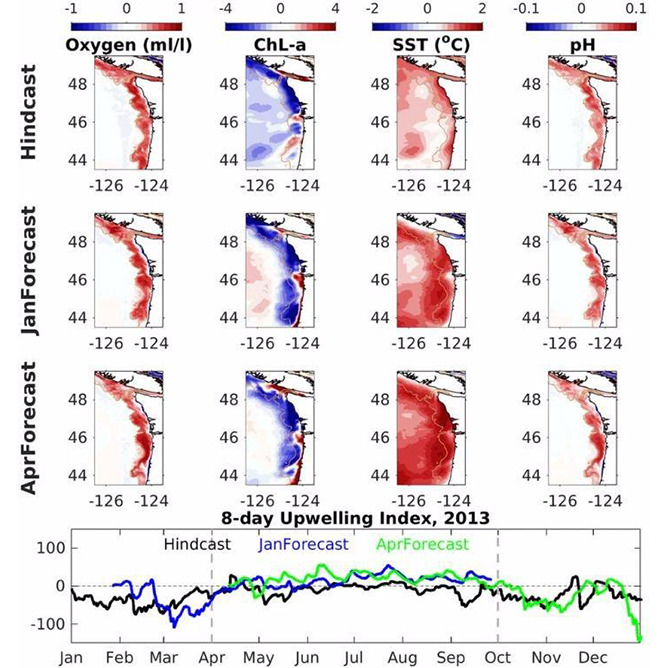
FORECASTING

Using models and research to understand the sensitivity of organisms and ecosystems to ocean acidification to make predictions about the future, allowing communities and industries to prepare

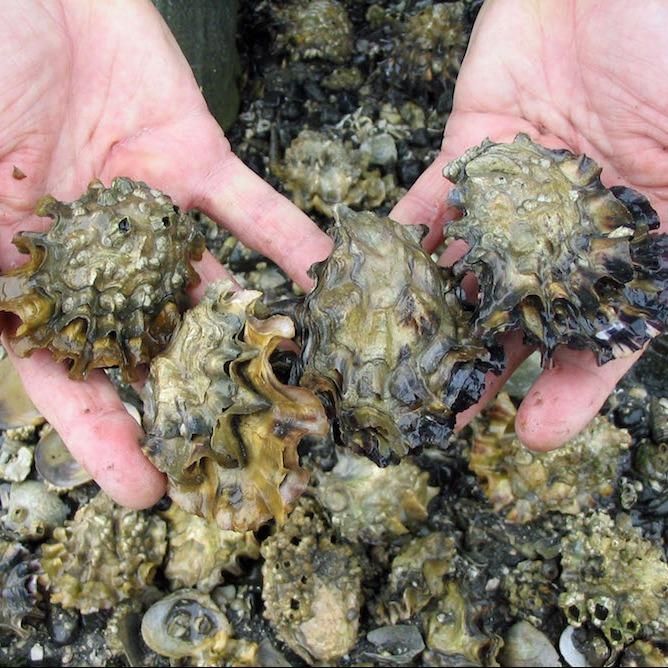
Closeup of oysters cupped in someone's hands

MANAGEMENT

Using these models and predictions as tools to facilitate management strategies that will protect marine resources and communities from future changes

TECHNOLOGY DEVELOPMENT

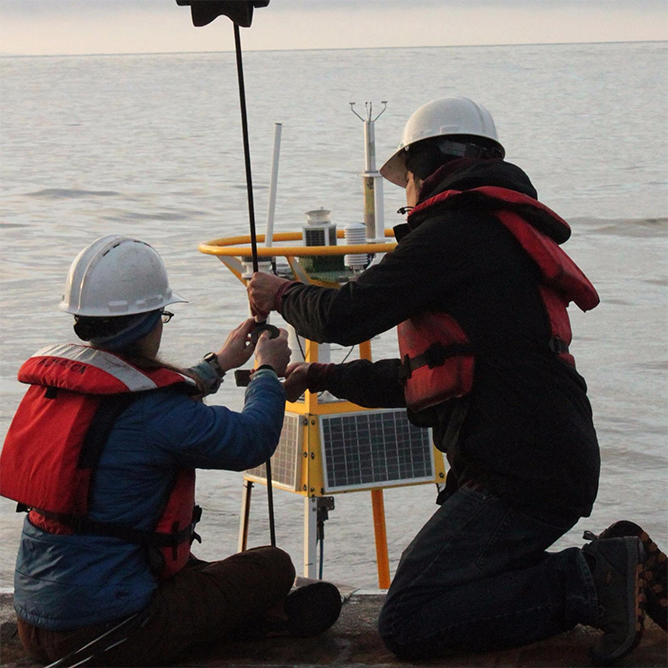
Developing innovative tools to help monitor ocean acidification and mitigate changing ocean chemistry locally

REDUCING OUR CARBON FOOTPRINT

On the Road

Drive fuel-efficient vehicles or choose public transportation. Choose your bike or walk! Don't sit idle for more than 30 seconds. Keep your tires properly inflated.

With your Food Choices

Eat local- this helps cut down on production and transport! Reduce your meat and dairy. Compost to avoid food waste ending up in the landfill

With your Food Choices

Make energy-efficient choices for your appliances and lighting. Heat and cool efficiently! Change your air filters and program your thermostat, seal and insulate your home, and support clean energy sources

By Reducing Coastal Acidification

Reduce your use of fertilizers, Improve sewage treatment and run off, and Protect and restore coastal habitats

TAKE ACTION WITH YOUR COMMUNITY

You've taken the first step to learn more about ocean acidification - why not spread this knowledge to your community?

Every community has their unique culture, economy and ecology and what’s at stake from ocean acidification may be different depending on where you live.  As a community member, you can take a larger role in educating the public about ocean acidification. Creating awareness is the first step to taking action.  As communities gain traction, neighboring regions that share marine resources can build larger coalitions to address ocean acidification.  Here are some ideas to get started:

  1. Work with informal educators, such as aquarium outreach programs and local non-profits, to teach the public about ocean acidification. Visit our Education & Outreach page to find the newest tools!
  2. Participate in habitat restoration efforts to restore habitats that help mitigate the effects of coastal acidification
  3. Facilitate conversations with local businesses that might be affected by ocean acidification, building a plan for the future.
  4. Partner with local community efforts to mitigate the driver behind ocean acidification  – excess CO2 – such as community supported agriculture, bike & car shares and other public transportation options.
  5. Contact your regional Coastal Acidification Network (CAN) to learn how OA is affecting your region and more ideas about how you can get involved in your community
       More for Taking Community Action