Official websites use .gov
A .gov website belongs to an official government organization in the United States.

Secure .gov websites use HTTPS
A lock ( ) or https:// means you’ve safely connected to the .gov website. Share sensitive information only on official, secure websites.

Monitoring & Modeling

Inorganic Carbon Transport and Dynamics in the Florida Straits

Ocean heat and carbon are transported through the Florida Straits, contributing to the Atlantic Meridional Overturning Circulation, and playing an important role in climate. Insufficient observations of carbonate chemistry within the Florida Straits have limited our understanding of ocean acidification within this region. To examine carbonate chemistry and carbon transport dynamics within this region, we […]

Inorganic Carbon Transport and Dynamics in the Florida Straits Read More »

Evaluating the time to detect biological effects of ocean acidification and warming: an example using simulations of purple sea urchin settlement

Ocean acidification (OA) and ocean warming driven by climate change are important stressors for marine species and systems, but documenting and detecting their long-term impacts on biological responses outside of laboratory settings are challenging due to natural variability caused by complex processes and interactions. We used settlement of purple sea urchins Strongylocentrotus purpuratus in the Southern California

Evaluating the time to detect biological effects of ocean acidification and warming: an example using simulations of purple sea urchin settlement Read More »

Capturing uncertainty when modelling environmental drivers of fish populations, with an illustrative application to Pacific Cod in the eastern Bering Sea

Decision makers are increasingly requesting that environmental and climate drivers be included in stock assessments and subsequent projections that provide managers with advice on the consequences of applying harvest control rules. Another key direction in stock assessment science is to capture the full range of uncertainty (model, process, and estimation). However, multiple sources of uncertainty are rarely

Capturing uncertainty when modelling environmental drivers of fish populations, with an illustrative application to Pacific Cod in the eastern Bering Sea Read More »

Inorganic Carbon Transport and Dynamics in the Florida Straits

Ocean heat and carbon are transported through the Florida Straits, contributing to the Atlantic Meridional Overturning Circulation, and playing an important role in climate. Insufficient observations of carbonate chemistry within the Florida Straits have limited our understanding of ocean acidification within this region. To examine carbonate chemistry and carbon transport dynamics within this region, we

Inorganic Carbon Transport and Dynamics in the Florida Straits Read More »

Quantification of the Dominant Drivers of Acidification in the Coastal Mid-Atlantic Bight

The coastal ocean is experiencing changes in chemistry due to human activities, including carbon dioxide emissions, nutrient runoff, and seasonal changes in temperature, salinity, and coastal currents. These drivers have been studied close to shore and/or only during single seasons, leaving a gap in our understanding of seasonal changes across the entire economically important shelf

Quantification of the Dominant Drivers of Acidification in the Coastal Mid-Atlantic Bight Read More »

Best Practice Data Standards for Discrete Chemical Oceanographic Observations

Effective data management plays a key role in oceanographic research as cruise-based data, collected from different laboratories and expeditions, are commonly compiled to investigate regional to global oceanographic processes. Here we describe new and updated best practice data standards for discrete chemical oceanographic observations, specifically those dealing with column header abbreviations, quality control flags, missing

Best Practice Data Standards for Discrete Chemical Oceanographic Observations Read More »

An updated version of the global interior ocean biogeochemical data product, GLODAPv2.2021

The Global Ocean Data Analysis Project (GLODAP) is a synthesis effort providing regular compilations of surface-to-bottom ocean biogeochemical bottle data, with an emphasis on seawater inorganic carbon chemistry and related variables determined through chemical analysis of seawater samples. GLODAPv2.2021 is an update of the previous version, GLODAPv2.2020 (Olsen et al., 2020). The major changes are

An updated version of the global interior ocean biogeochemical data product, GLODAPv2.2021 Read More »

Advancing best practices for assessing trends of ocean acidification time series

Assessing the status of ocean acidification across ocean and coastal waters requires standardized procedures at all levels of data collection, dissemination, and analysis. Standardized procedures for assuring quality and accessibility of ocean carbonate chemistry data are largely established, but a common set of best practices for ocean acidification trend analysis is needed to enable global

Advancing best practices for assessing trends of ocean acidification time series Read More »

Quantifying Net Community Production and Calcification at Station ALOHA Near Hawai’i: Insights and Limitations From a Dual Tracer Carbon Budget Approach

A budget approach is used to disentangle drivers of the seasonal mixed layer carbon cycle at Station ALOHA (A Long-term Oligotrophic Habitat Assessment) in the North Pacific Subtropical Gyre (NPSG). The budget utilizes data from the WHOTS (Woods Hole—Hawaii Ocean Time-series Site) mooring, and the ship-based Hawai’i Ocean Time-series (HOT) in the NPSG, a region

Quantifying Net Community Production and Calcification at Station ALOHA Near Hawai’i: Insights and Limitations From a Dual Tracer Carbon Budget Approach Read More »

Assessing drivers of estuarine pH: A comparative analysis of the continental U.S.A.’s two largest estuaries

In estuaries, local processes such as changing material loads from the watershed and complex circulation create dynamic environments with respect to ecosystem metabolism and carbonate chemistry that can strongly modulate impacts of global atmospheric CO2 increases on estuarine pH. Long-term (> 20 yr) surface water pH records from the USA’s two largest estuaries, Chesapeake Bay (CB) and

Assessing drivers of estuarine pH: A comparative analysis of the continental U.S.A.’s two largest estuaries Read More »

Forecasts for Alaska Fisheries

Crab pots and fishing nets in Alaska's Dutch Harbor
Image credit: Michael Theberge

Understanding seasonal changes in ocean acidification in Alaskan waters and the potential impacts to the multi-billion-dollar fishery sector is a main priority. Through work funded by NOAA’s Ocean Acidification Program, the Pacific Marine Environmental Laboratory developed a model capable of depicting past ocean chemistry conditions for the Bering Sea and is now testing the ability of this model to forecast future conditions. This model is being used to develop an ocean acidification indicator provided to fisheries managers in the annual NOAA Eastern Bering Sea Ecosystem Status Report.

ADAPTING TO OCEAN ACIDIFICATION

The NOAA Ocean Acidification Program (OAP) works to prepare society to adapt to the consequences of ocean acidification and conserve marine ecosystems as acidification occurs. Learn more about the human connections and adaptation strategies from these efforts.

Adaptation approaches fostered by the OAP include:

FORECASTING

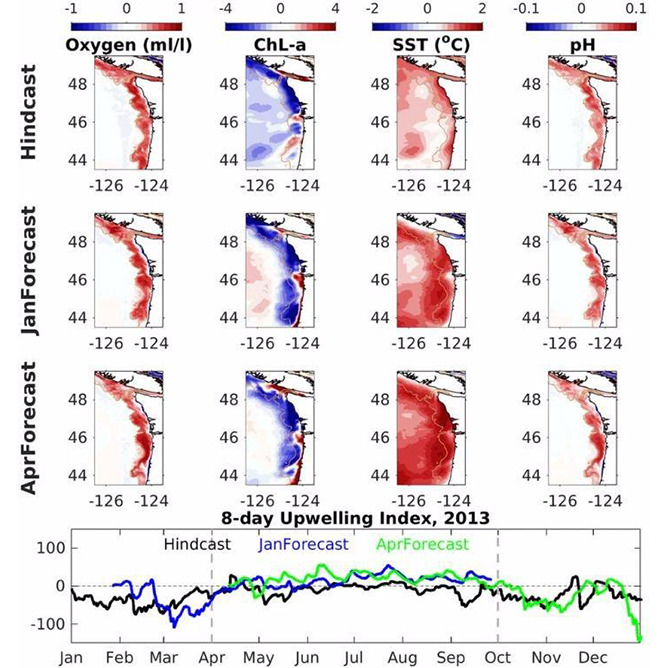
Using models and research to understand the sensitivity of organisms and ecosystems to ocean acidification to make predictions about the future, allowing communities and industries to prepare

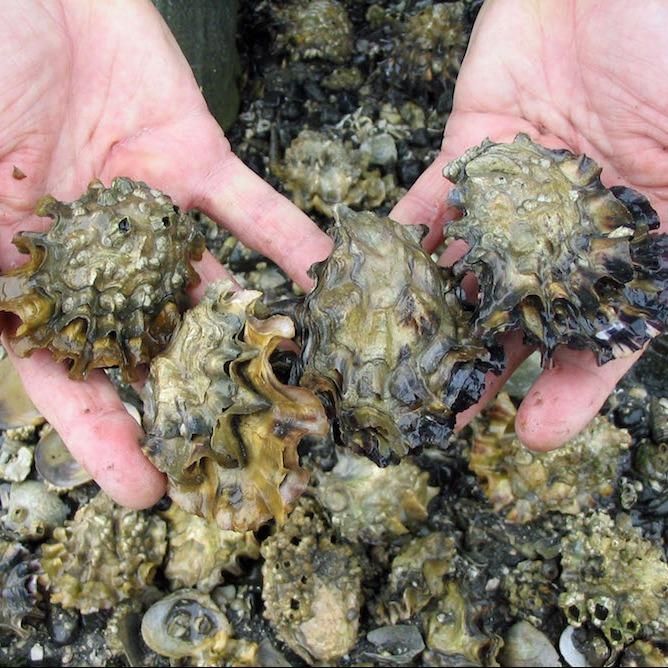
Closeup of oysters cupped in someone's hands

MANAGEMENT

Using these models and predictions as tools to facilitate management strategies that will protect marine resources and communities from future changes

TECHNOLOGY DEVELOPMENT

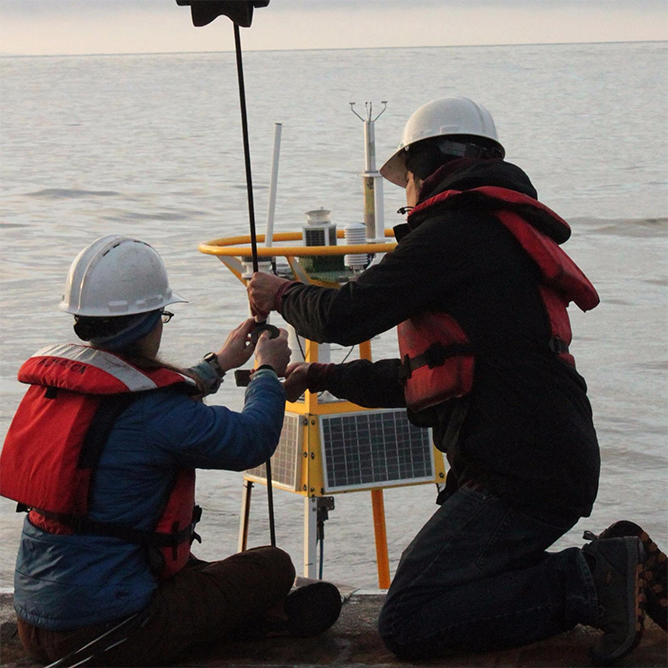
Developing innovative tools to help monitor ocean acidification and mitigate changing ocean chemistry locally

REDUCING OUR CARBON FOOTPRINT

On the Road

Drive fuel-efficient vehicles or choose public transportation. Choose your bike or walk! Don't sit idle for more than 30 seconds. Keep your tires properly inflated.

With your Food Choices

Eat local- this helps cut down on production and transport! Reduce your meat and dairy. Compost to avoid food waste ending up in the landfill

With your Food Choices

Make energy-efficient choices for your appliances and lighting. Heat and cool efficiently! Change your air filters and program your thermostat, seal and insulate your home, and support clean energy sources

By Reducing Coastal Acidification

Reduce your use of fertilizers, Improve sewage treatment and run off, and Protect and restore coastal habitats

TAKE ACTION WITH YOUR COMMUNITY

You've taken the first step to learn more about ocean acidification - why not spread this knowledge to your community?

Every community has their unique culture, economy and ecology and what’s at stake from ocean acidification may be different depending on where you live.  As a community member, you can take a larger role in educating the public about ocean acidification. Creating awareness is the first step to taking action.  As communities gain traction, neighboring regions that share marine resources can build larger coalitions to address ocean acidification.  Here are some ideas to get started:

  1. Work with informal educators, such as aquarium outreach programs and local non-profits, to teach the public about ocean acidification. Visit our Education & Outreach page to find the newest tools!
  2. Participate in habitat restoration efforts to restore habitats that help mitigate the effects of coastal acidification
  3. Facilitate conversations with local businesses that might be affected by ocean acidification, building a plan for the future.
  4. Partner with local community efforts to mitigate the driver behind ocean acidification  – excess CO2 – such as community supported agriculture, bike & car shares and other public transportation options.
  5. Contact your regional Coastal Acidification Network (CAN) to learn how OA is affecting your region and more ideas about how you can get involved in your community
       More for Taking Community Action