Official websites use .gov
A .gov website belongs to an official government organization in the United States.

Secure .gov websites use HTTPS
A lock ( ) or https:// means you’ve safely connected to the .gov website. Share sensitive information only on official, secure websites.

NOAA’s Ocean Acidification Program Research Region

Region: Northeast

Related Posts

See news related to this Research Region

Mechanical Resistance in Decapod Claw Denticles: Contribution of Structure and Composition

The decapod crustacean exoskeleton is a multi-layered structure composed of chitin-protein fibers embedded with calcium salts. Decapod claws display tooth-like denticles, which come into direct contact with predators and prey. They are subjected to more regular and intense mechanical stress than other parts of the exoskeleton and therefore must be especially resistant to wear and abrasion. Here,

Read More >

Experimental acidification increases susceptibility of <em>Mercenaria mercenaria</em> to infection by Vibrio species

Ocean acidification alters seawater carbonate chemistry, which can have detrimental impacts for calcifying organisms such as bivalves. This study investigated the physiological cost of resilience to acidification in Mercenaria mercenaria, with a focus on overall immune performance following exposure to Vibrio spp. Larval and juvenile clams reared in seawater with high pCO2 (~1200 ppm) displayed an enhanced susceptibility to bacterial pathogens. Higher

Read More >

The challenges of detecting and attributing ocean acidification impacts on marine ecosystems

A substantial body of research now exists demonstrating sensitivities of marine organisms to ocean acidification (OA) in laboratory settings. However, corresponding in situ observations of marine species or ecosystem changes that can be unequivocally attributed to anthropogenic OA are limited. Challenges remain in detecting and attributing OA effects in nature, in part because multiple environmental changes are

Read More >

Physiological feeding rates and cilia suppression in blue mussels (<em>Mytilus edulis</eM>) with increased levels of dissolved carbon dioxide

Gills of marine bivalves, the organs that mediate water flow for feeding and other physiological functions, are exposed to increasing levels of carbon dioxide (CO2) in seawater, in response to ocean acidification (OA). We examined the effects of elevated dissolved CO2 upon filtration and feeding behavior of the blue mussel, Mytilus edulis, under field conditions and in laboratory

Read More >

Multiple Linear Regression Models for Reconstructing and Exploring Processes Controlling the Carbonate System of the Northeast US From Basic Hydrographic Data

In the coastal ocean, local carbonate system variability is determined by the interaction between ocean acidification and local processes. Sporadic observations indicate that biological metabolism, river input, and water mass mixing are dominant local processes driving carbonate system variability in northeast US shelf waters. These processes are also reflected in the variability of observed temperature

Read More >

Synoptic assessment of coastal total alkalinity through community science

Comprehensive sampling of the carbonate system in estuaries and coastal waters can be difficult and expensive because of the complex and heterogeneous nature of near-shore environments. We show that sample collection by community science programs is a viable strategy for expanding estuarine carbonate system monitoring and prioritizing regions for more targeted assessment. ‘Shell Day’ was

Read More >

A Transcriptomic Analysis of Phenotypic Plasticity in Crassostrea virginica Larvae under Experimental Acidification

Ocean acidification (OA) is a major threat to marine calcifiers, and little is known regarding acclimation to OA in bivalves. This study combined physiological assays with next-generation sequencing to assess the potential for recovery from and acclimation to OA in the eastern oyster (Crassostrea virginica) and identify molecular mechanisms associated with resilience. In a reciprocal

Read More >

Climatological distribution of ocean acidification variables along the North American ocean margins

Climatologies that depict mean fields of oceanographic variables on a regular geographic grid, and atlases play pivotal roles in comprehending the societal vulnerabilities linked to ocean acidification (OA). This significance is particularly pronounced in coastal regions where most economic activities occur. This work provides a comprehensive data product featuring 10 coastal ocean acidification climatologies and

Read More >

Resilience of Black Sea Bass Embryos to Increased Levels of Carbon Dioxide

After a decade of research on how embryonic fish will respond to the increased dissolved carbon dioxide (ρCO2) levels predicted for the next century, no uniform response to near future acidification has been observed among marine species. We exposed Black Sea Bass Centropristis striata (BSB) embryos to varied levels of ρCO2 (microatmospheres [μatm]) for 48 h during seasonal experiments

Read More >

Related Projects

See our funded projects for this Focus Area

A full view of a sea scallop sitting on top of a pile of sea scallops shells.
This project will enhance the adaptive capacity of the Atlantic sea scallop fishery to ocean acidification and ocean change...
A satellite map of the Chesapeake Bay region. The waterways are color coded to show degrees of alkalinity, with the general trend of higher alkalinity upriver and lower alkalinity toward the ocean.
This project produces a dashboard for Chesapeake Bay users to assist with adaptive strategies for ocean and coastal acidification...
Satellite view of the Mississippi River plume in the Gulf of America. You can see sediment discharging into the Gulf. Credit: NASA
This work will assess the economic and community impacts of ocean and coastal acidification within coastal Louisiana to assist adaptive planning...
Intertidal marine life including Pisaster sea stars and mussles, partially submerged on a rock.
This project provides tools communities and decision makers in Southeast Alaska can use for assessing vulnerability and resilience to ocean acidification and inform adaptive strategies...
Sunrise on a coastal town in Maine
This project assesses the potential risk to the shellfish industry from changing ocean chemistry and is a critical step in advancing resilience in Maine’s shellfisheries...
Ruby beach as seen from a lookout, there are high cliffs in the foreground with partially submerged large and small rocks in the water behind them. Sky is dusky and cloudy.
This project provides practical information and products to support adaptation planning for coastal tribes in Washington...

Related Publications

See publications produced by our funded projects for this Focus Area

Modeling the spatiotemporal effects of ocean acidification and warming on Atlantic sea scallop growth to guide adaptive fisheries management
Citation: Halle M. Berger, Samantha A. Siedlecki, Shannon L. Meseck, Emilien Pousse, Deborah R. Hart, Felipe Soares, Antonie Chute, Catherine M. Matassa, Modeling the spatiotemporal effects of ocean acidification and warming on Atlantic sea scallop growth to guide adaptive fisheries management, Ecological Modelling, Volume 513, 2026, 111434, https://doi.org/10.1016/j.ecolmodel.2025.111434.
Mothers know best: Maternal signaling boosts larval resilience under ocean acidification conditions
Citation: Timmins-Schiffman, E., Root, L., Crim, R., Middleton, M. A., Ewing, M. M., Winnikoff, J., Ham, G., Goetz, G., Roberts, S., & Gavery, M. (2026). Mothers know best: Maternal signaling boosts larval resilience under ocean acidification conditions. Aquaculture. https://doi.org/10.1016/j.aquaculture.2025.743388
Assessment framework to predict sensitivity of marine calcifiers to ocean alkalinity enhancement – identification of biological thresholds and importance of precautionary principle
Citation: Bednaršek, N., van de Mortel, H., Pelletier, G., García-Reyes, M., Feely, R. A., and Dickson, A. G.: Assessment framework to predict sensitivity of marine calcifiers to ocean alkalinity enhancement – identification of biological thresholds and importance of precautionary principle, Biogeosciences, 22, 473–498, https://doi.org/10.5194/bg-22-473-2025, 2025.

Forecasts for Alaska Fisheries

Crab pots and fishing nets in Alaska's Dutch Harbor
Image credit: Michael Theberge

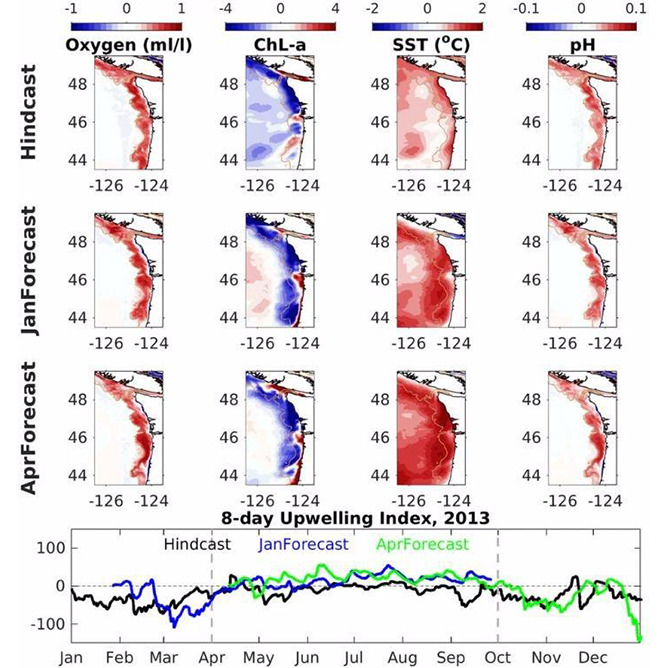
Understanding seasonal changes in ocean acidification in Alaskan waters and the potential impacts to the multi-billion-dollar fishery sector is a main priority. Through work funded by NOAA’s Ocean Acidification Program, the Pacific Marine Environmental Laboratory developed a model capable of depicting past ocean chemistry conditions for the Bering Sea and is now testing the ability of this model to forecast future conditions. This model is being used to develop an ocean acidification indicator provided to fisheries managers in the annual NOAA Eastern Bering Sea Ecosystem Status Report.

ADAPTING TO OCEAN ACIDIFICATION

The NOAA Ocean Acidification Program (OAP) works to prepare society to adapt to the consequences of ocean acidification and conserve marine ecosystems as acidification occurs. Learn more about the human connections and adaptation strategies from these efforts.

Adaptation approaches fostered by the OAP include:

FORECASTING

Using models and research to understand the sensitivity of organisms and ecosystems to ocean acidification to make predictions about the future, allowing communities and industries to prepare

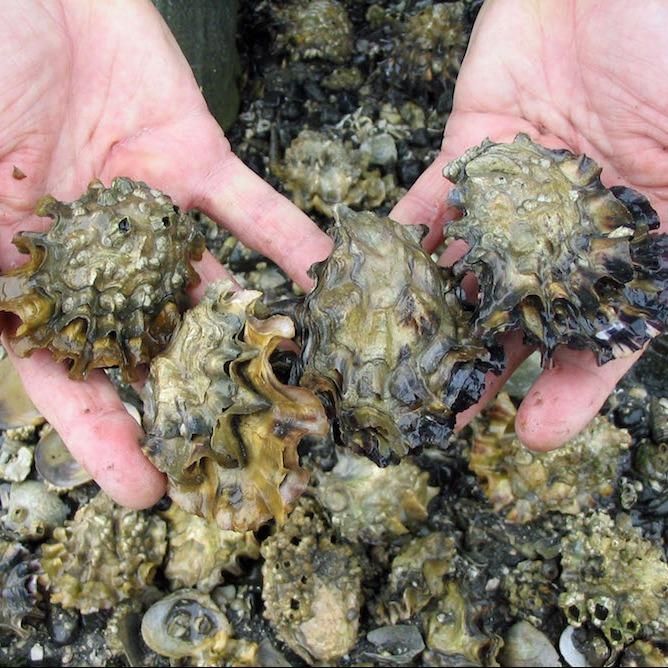
Closeup of oysters cupped in someone's hands

MANAGEMENT

Using these models and predictions as tools to facilitate management strategies that will protect marine resources and communities from future changes

TECHNOLOGY DEVELOPMENT

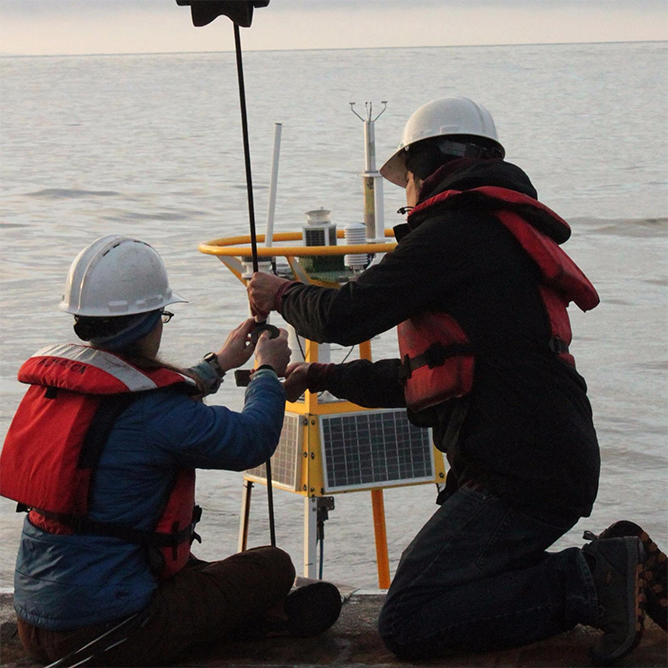
Developing innovative tools to help monitor ocean acidification and mitigate changing ocean chemistry locally

REDUCING OUR CARBON FOOTPRINT

On the Road

Drive fuel-efficient vehicles or choose public transportation. Choose your bike or walk! Don't sit idle for more than 30 seconds. Keep your tires properly inflated.

With your Food Choices

Eat local- this helps cut down on production and transport! Reduce your meat and dairy. Compost to avoid food waste ending up in the landfill

With your Food Choices

Make energy-efficient choices for your appliances and lighting. Heat and cool efficiently! Change your air filters and program your thermostat, seal and insulate your home, and support clean energy sources

By Reducing Coastal Acidification

Reduce your use of fertilizers, Improve sewage treatment and run off, and Protect and restore coastal habitats

TAKE ACTION WITH YOUR COMMUNITY

You've taken the first step to learn more about ocean acidification - why not spread this knowledge to your community?

Every community has their unique culture, economy and ecology and what’s at stake from ocean acidification may be different depending on where you live.  As a community member, you can take a larger role in educating the public about ocean acidification. Creating awareness is the first step to taking action.  As communities gain traction, neighboring regions that share marine resources can build larger coalitions to address ocean acidification.  Here are some ideas to get started:

  1. Work with informal educators, such as aquarium outreach programs and local non-profits, to teach the public about ocean acidification. Visit our Education & Outreach page to find the newest tools!
  2. Participate in habitat restoration efforts to restore habitats that help mitigate the effects of coastal acidification
  3. Facilitate conversations with local businesses that might be affected by ocean acidification, building a plan for the future.
  4. Partner with local community efforts to mitigate the driver behind ocean acidification  – excess CO2 – such as community supported agriculture, bike & car shares and other public transportation options.
  5. Contact your regional Coastal Acidification Network (CAN) to learn how OA is affecting your region and more ideas about how you can get involved in your community
       More for Taking Community Action